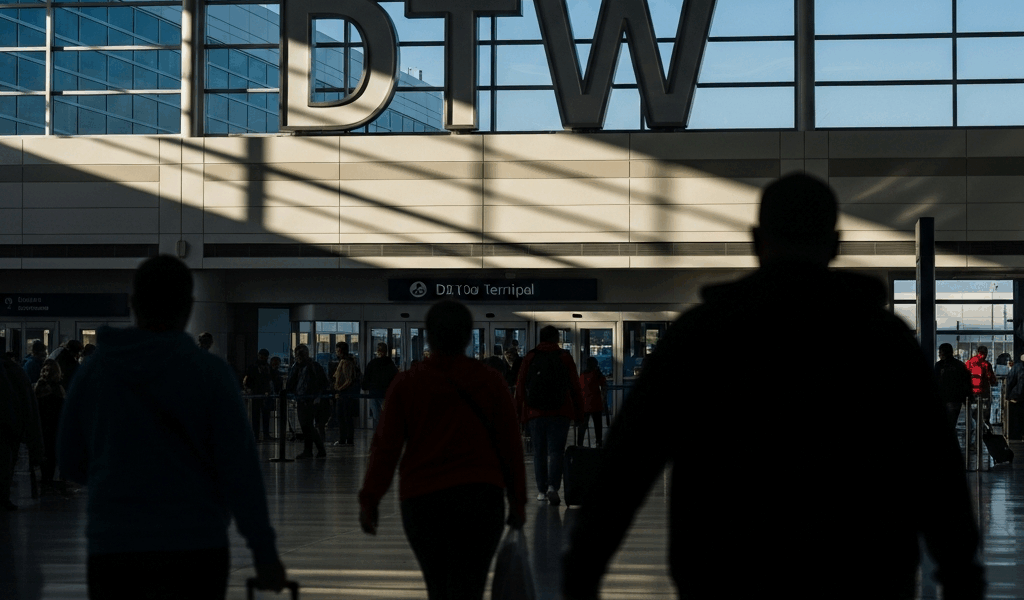
Why Is Detroit Airport Code DTW? What the Letters Mean
The Detroit airport code DTW is one of those things that looks totally logical right up until you stare at it for a second too long. D for Detroit, T for… the? W for… wait. I’ve flown through Detroit Metropolitan Airport more times than I can count — connecting flights, holiday travel, one deeply regrettable Spirit Airlines booking that I will not be revisiting — and it wasn’t until a gate agent at Concourse A made an offhand comment that I actually understood what those three letters meant. The T and the W aren’t random. They’re not leftovers from some outdated naming system. They tell you exactly where the airport sits, geographically and politically, if you know what you’re looking for.
DTW — Detroit Wayne Metropolitan Airport
Here’s the direct answer: DTW stands for Detroit Wayne, with the full official name being Detroit Metropolitan Wayne County Airport. The D is Detroit, the T is Metropolitan (yes, really — the T comes from the middle of that word), and the W is Wayne County. That last letter is the one most people miss entirely.
When you see DTW on a boarding pass, you’re not just seeing an abbreviation for a city. You’re seeing the name of the county the airport actually sits in. Wayne County is one of Michigan’s 83 counties, and it happens to be the most populous one, containing Detroit itself along with a ring of surrounding communities. The airport bears the county’s name because the county government has historically had authority over the facility. This isn’t unusual in American aviation — plenty of major airports carry county or regional names rather than just city names — but it’s the kind of detail that gets lost when you’re just trying to find your gate.
Here’s the part worth saying first. The Metropolitan part throwing people off is the real culprit. Most people assume the T stands for something airport-specific, like terminal or transport. It doesn’t. It’s just the first consonant that makes DTW feel pronounceable and distinct when spoken aloud over a radio or intercom. Metropolitan Detroit has been a way of referring to the greater Detroit region since at least the early 20th century, and when the airport needed a code, the full name — Detroit Metropolitan Wayne County Airport — got compressed into those three letters in a way that kept both the regional identity and the county identity intact.
What I got wrong for years: I assumed the W was just a filler character. Something tacked on to make the code unique because DET or DTA was already taken. That’s not how it works, and the Wayne County angle is genuinely more interesting than a random letter assignment would be.
Why Wayne County Matters
Detroit Metropolitan Airport is not in Detroit. That surprises a lot of people, including me the first time I drove out there and kept expecting to see the city skyline. The airport sits in Romulus, Michigan — a city of about 23,000 people roughly 20 miles southwest of downtown Detroit. Romulus is quiet, mostly flat, and almost entirely surrounded by the infrastructure that supports the airport itself. There’s a Marriott and a couple of budget hotels along Merriman Road near the terminals, the kind of places with free shuttles and breakfast buffets that start at 5:30 a.m. for the early departure crowd. Romulus is not Detroit. But Romulus is in Wayne County.
That county designation is what ties the airport back to Detroit in any official sense. Wayne County was established in 1815, named after General Anthony Wayne, the Revolutionary War general who played a key role in securing the Northwest Territory for the United States. The county seat is Detroit. So when the airport was developed and named, attaching Wayne County to the identity was a way of anchoring it to the regional power center even though the physical facility sits in a different municipality entirely.
The airport’s history on that site goes back to 1930, when Wayne County purchased land near Romulus to develop a commercial aviation facility. The original name was simply Wayne County Airport. Over the following decades, as commercial aviation expanded dramatically and Detroit grew into one of the country’s major industrial centers, the airport expanded too. The Metropolitan piece got added to the name as the airport grew to serve not just Detroit but the broader metro region — Dearborn, Livonia, Ann Arbor, and communities across southeastern Michigan and into Ohio. By the time jet service became standard in the late 1950s and early 1960s, the airport had already established its identity as a regional hub rather than a single-city facility.
The name change to Detroit Metropolitan Wayne County Airport came as the airport continued to develop its identity, and when IATA codes were being standardized across North American airports, the existing name gave the coding system enough material to work with. D for Detroit, T for Metropolitan, W for Wayne. Three letters. Done.
There’s something worth sitting with here: the code preserves a layer of local government authority that most passengers never think about. When you type DTW into Google Flights and pull up departure times, you’re technically referencing a county-owned airport that operates under Wayne County’s jurisdiction. That’s not typical for major American hub airports. O’Hare is city-owned. Hartsfield-Jackson is city-owned. DTW has a different governance structure, and the code encodes that difference whether travelers realize it or not.
How Three-Letter Airport Codes Get Assigned
Stumped by a code on your boarding pass at least once in your life? You’re in good company. The system that produces these codes is managed by the International Air Transport Association, which goes by IATA — the organization responsible for the three-letter codes that appear on luggage tags, boarding passes, and booking systems worldwide. A separate organization, the International Civil Aviation Organization (ICAO), maintains its own four-letter coding system used primarily by pilots and air traffic controllers. When you see DTW on your ticket, that’s the IATA code. The ICAO equivalent for Detroit Metro is KDTW — the K prefix applies to airports in the contiguous United States.
IATA codes don’t follow a single rule. Some are intuitive: LAX for Los Angeles, ORD for Chicago O’Hare (originally Orchard Field — that’s a whole other story), JFK for John F. Kennedy. Some seem random because the obvious options were already taken. ATL for Atlanta makes sense. But MSP for Minneapolis-Saint Paul, CLT for Charlotte, and DTW for Detroit all require a little unpacking.
The general principle is that codes are assigned to be unique, pronounceable, and ideally derived from the airport’s official name or location. When an airport opens or is renamed, the existing code usually stays in place to avoid disrupting airline systems, booking databases, and the approximately 10,000 places a code gets embedded in aviation infrastructure. Changing a code is a significant operational undertaking. This is part of why ORD still carries the ghost of Orchard Field in its letters even though O’Hare International Airport hasn’t been called that since 1949.
For DTW specifically, the code has been stable for decades. Delta Air Lines, which operates a major hub at Detroit Metro, has built extensive route infrastructure around the code. When you search DL flights through DTW, you’re pulling from a database architecture that treats those three letters as a fixed anchor point. The code isn’t going anywhere.
One more thing worth knowing: the two terminal buildings at Detroit Metro are called the McNamara Terminal and the North Terminal. The McNamara Terminal, which opened in 2002 at a construction cost of around $1.2 billion, is one of the longest airport terminals in the world — stretching nearly a mile from end to end. It has an underground tram, a food court that’s better than it has any right to be, and a light tunnel between concourses that becomes a mild tourist attraction for people on long layovers. None of that changes the code, but it does make DTW a more interesting place to be stuck for two hours than most connecting airports. The letters on your boarding pass don’t tell you any of that. Now you know where to look them up.


Stay in the loop
Get the latest airport pin updates delivered to your inbox.