The Two-Letter Problem That Started Everything
Airport codes have changed quite a bit thanks to the mythology flying around. Everyone assumes there’s clever wordplay or hidden meaning baked into those three letters on your luggage tag. Sometimes there is. Often there isn’t. And LAX — probably the most recognized airport code in the world — is the perfect example of why.
So, without further ado, let’s dive in.
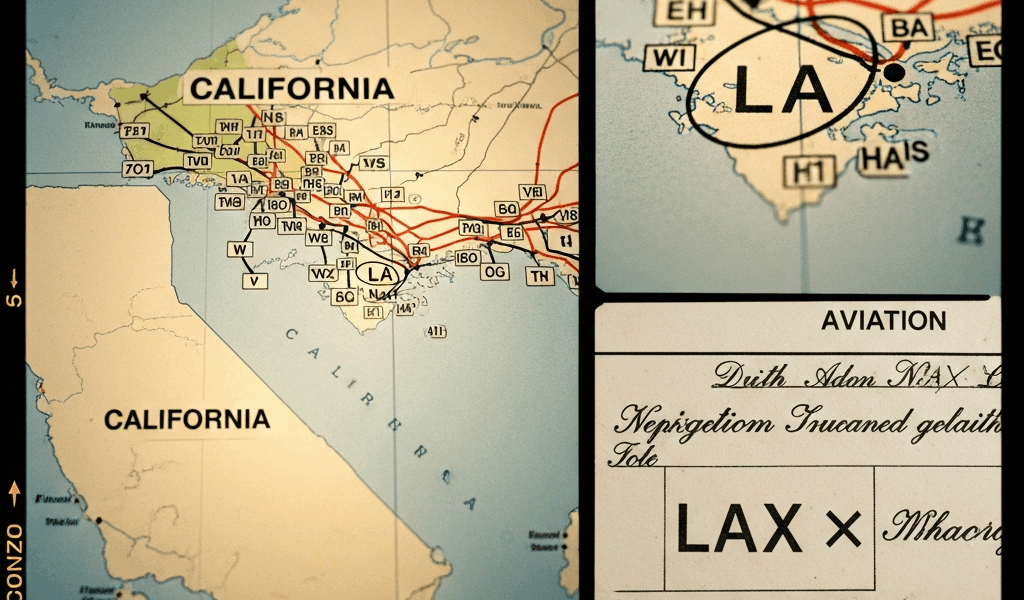
Back in the early 1930s, radio operators and weather stations needed fast identifiers for telegraph and radio signals. Two letters did the job fine. LA meant Los Angeles. SF meant San Francisco. NY meant New York. Clean, fast, no confusion — at least until aviation showed up and broke everything.
As commercial flights started operating in the late 1920s and into the 1930s, the aviation industry and the U.S. Weather Bureau ran into a wall. Two-letter codes created conflicts. A weather station and an airport couldn’t share the same identifier without dispatchers getting confused. Safety margins got thin. The whole system started creaking under the weight of a rapidly expanding industry.
The fix was obvious: go to three letters. But here’s where the real story gets interesting — and where most explanations get it wrong.
What the X in LAX Actually Means
The piece that matters most here.
I spent an embarrassing amount of time digging through the history of IATA coding conventions looking for some hidden connection between X and Los Angeles. Something geographic. Something cultural. A mnemonic device. Anything. I found nothing — because there’s nothing to find. The X means nothing. It was never supposed to.
But what is an IATA airport code, really? In essence, it’s a standardized three-letter identifier used on tickets, luggage tags, and airline systems worldwide. But it’s much more than that — it’s a living artifact of 1930s telecommunications infrastructure still embedded in modern global aviation.
When the International Air Transport Association was formalizing three-letter codes in the 1930s and 1940s, the rule was straightforward: take the existing two-letter weather station code and append a third letter to prevent conflicts. Los Angeles was already coded as LA. The city’s two-letter identity was locked in with decades of use behind it. Adding X to the end was the mechanical solution — administrative, functional, the kind of decision made by a committee working down a checklist at 2pm on a Tuesday.
Was X chosen randomly? Not quite. The IATA avoided vowels and steered clear of letters that would conflict with other codes nearby. But X wasn’t chosen because it represented anything about Los Angeles. LAX therefore reflects a practical transition from two-letter to three-letter airport identifiers rather than a hidden reference to the city or airport.
Every time you see LAX on a baggage sticker or hear it rattled off in a film, you’re looking at a fossilized telegraph system. Most people assume these codes carry meaning. LAX proves otherwise.
How IATA and the FAA Divide Up the Alphabet
Two separate systems govern airport identification in the United States. The IATA produces the three-letter codes on your boarding pass — LAX, JFK, ORD, SFO. The FAA uses four-letter codes for flight plans and air traffic control — KLAX, KJFK, KORD, KSFO. That K prefix marks airports in the continental United States. Simple enough once you know it.
The IATA codes grew directly out of the weather station system. The FAA codes came later, layered on top of that existing infrastructure. This two-system approach is exactly why LAX never got a more “meaningful” code — by the time IATA locked in its three-letter standard, LA had already accumulated decades of use as a two-letter identifier. Changing it would have created far more problems than it solved. So they didn’t.
That was the 1940s. And we’re still living with those decisions today.
Other US Airports That Got the X Treatment
LAX wasn’t the only airport that got an X stapled to the end. Once you know the pattern, you start seeing it everywhere:
- PHX — Phoenix Sky Harbor. PH was the weather code. X got added. Now it handles over 40 million passengers a year.
- PDX — Portland International. PD became PDX. Same logic, same era.
- TUX — Tumwater, Washington. Small airport, same naming pattern — no exceptions made for size.
- MFE — McAllen-Miller International in Texas. This one landed an E instead of X, but the underlying principle is identical — append a letter, avoid a conflict, move on.
- DEN — Denver International. Two letters expanded into three. The methodology doesn’t change.
Once you see the pattern, airport codes stop looking random. They become a readable history of how American infrastructure standardized itself across radio waves and bureaucratic necessity — one letter at a time.
Why LAX Stuck and Became an Icon
Los Angeles International Airport opened in 1949. LAX as a code predates it by more than a decade — the identifier was sitting there waiting, inherited wholesale from the weather station system. What happened after that has less to do with the code’s origins and more to do with what Los Angeles itself became.
Frustrated by decades of operating under cramped, outdated facilities, city planners rebuilt LAX through the 1950s and 1960s into something genuinely cinematic. The Theme Building — that spider-legged UFO parked in the middle of the airport — opened in 1961 for around $2.2 million. It was a statement. LAX wasn’t just infrastructure anymore. It was imagery.
Movies helped cement it. So did the sheer gravitational pull of the city. LAX isn’t the world’s busiest airport — that title bounces between Atlanta and Dubai depending on the year — but it’s visible enough, glamorous enough, and culturally loaded enough that the three letters entered the vocabulary like almost no other code ever has. Kids recognize it. It ends up on tote bags and stickers and film posters. It became more synonymous with Los Angeles than the two-letter LA it descended from.
I’m apparently someone who finds this genuinely fascinating, and digging through IATA archives works for me while skimming Wikipedia never quite cuts it. Save yourself the trouble I had of starting with the surface-level explanation. The real story is better.
A code that started as a mechanical fix to a telegraph-era conflict transformed — accidentally — into a global brand. That’s what makes LAX endearing to all of us. Not meaning. Accidental destiny.

Stay in the loop
Get the latest airport pin updates delivered to your inbox.