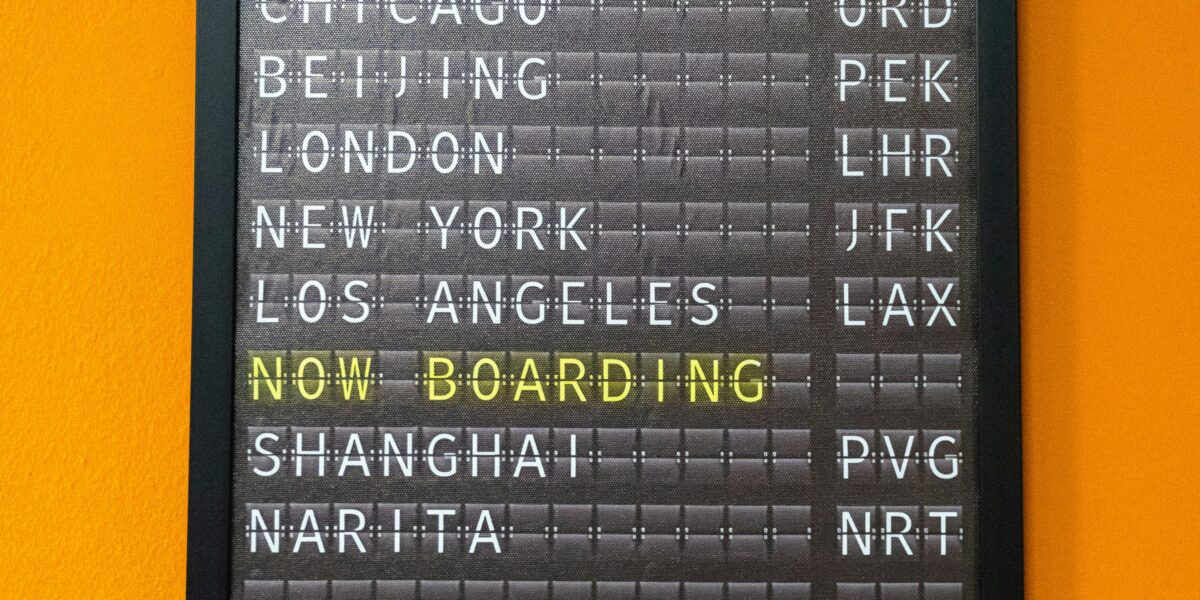
How New Airports Actually Get Their Three-Letter Codes
When a new airport opens, it needs an identifier—a unique three-letter code that pilots, airlines, and travelers will use for decades. The process of obtaining this code involves federal bureaucracy, historical precedent, and occasionally some creative lobbying. Here’s how airports actually get their codes.
Two Systems, Two Purposes
Every commercial airport operates with two different codes serving different purposes:
IATA codes: The three-letter codes travelers see on boarding passes and luggage tags. LAX, JFK, ORD. These codes are issued by the International Air Transport Association, the global airline trade organization. IATA codes exist for commercial purposes—ticketing, baggage handling, flight scheduling.
ICAO codes: Four-letter codes used by pilots and air traffic control worldwide. KLAX, KJFK, KORD for U.S. airports. These are issued by the International Civil Aviation Organization, a United Nations agency. ICAO codes are required for flight plans and international aviation communication.
A new airport needs both, obtained through separate processes from different organizations. The ICAO code comes first since aircraft operations require it. The IATA code follows once commercial service is planned.
The ICAO Code Process
ICAO codes follow a systematic global structure. The first letter indicates the region—K for the contiguous United States, C for Canada, E for Northern Europe, L for Southern Europe. The remaining letters identify the specific airport.
FAA assignment: In the United States, the FAA assigns ICAO codes for new airports. When an airport is built or an existing airfield seeks a code, the FAA’s Air Traffic Organization handles the request.
Format requirements: U.S. airport codes start with K followed by three letters. The FAA attempts to use codes that relate to the location or airport name, but with thousands of airports needing unique codes, options are limited.
Availability check: The FAA verifies the requested code isn’t already assigned globally. Since ICAO codes must be unique worldwide, a code used by an airport in Australia can’t be issued to an American airport.
Processing time: Standard requests take 4-8 weeks. The FAA publishes new codes in Notices to Air Missions (NOTAMs) and updates aeronautical publications.
The IATA Code Process
IATA codes are where commercial considerations and airport identity intersect. Airlines must use these codes in their reservation systems, so a memorable or geographically relevant code provides practical advantages.
Application: Airports apply to IATA’s Coding and Data Management team, submitting documentation including the airport’s official name, location, governing authority, and existing ICAO code.
Code selection: Airports can request specific codes, though IATA has final authority. Preferences typically include city name abbreviations (PHX for Phoenix), airport name abbreviations (DFW for Dallas-Fort Worth), or historical telegraph codes that predate aviation.
Availability: With only 17,576 possible three-letter combinations and thousands of airports worldwide, finding available codes that relate meaningfully to location is increasingly difficult. Many modern airports receive codes with no obvious connection to their names.
Approval timeline: IATA typically processes applications within 2-4 weeks for straightforward requests. Complex cases involving multiple stakeholders or disputed codes take longer.
Cost: IATA charges fees for code assignment and annual maintenance, though exact amounts vary based on airport size and services requested.
The Historical Wild West
Early airport codes weren’t assigned by any central authority. They evolved from National Weather Service station identifiers, railway telegraph codes, and simple abbreviations airports chose for themselves.
Weather station origins: Before aviation, the National Weather Service used two-letter codes for reporting stations. When aviation arrived, airports often adopted the local weather station’s code with an added letter. This explains codes like ORD (from “Orchard Field,” Chicago’s original airport name) and PDX (the weather station identifier for Portland).
Railway influence: Telegraph operators on the railroads used abbreviated codes for stations. Airports near major rail hubs sometimes inherited these codes. The “X” in many codes (LAX, PDX, PHX) was added to distinguish airport codes from existing railway codes.
Grandfathered codes: Airports that existed before centralized code assignment kept their historical identifiers. This is why some codes seem arbitrary—they made sense in 1930 and were never changed.
When Codes Don’t Match Names
Modern travelers often wonder why airport codes don’t match city names. History usually explains the discrepancy:
ORD (Chicago O’Hare): Originally Orchard Field, a Douglas aircraft manufacturing plant during World War II. The code stuck when the field became a commercial airport.
MSP (Minneapolis-St. Paul): Combines abbreviations from both cities, not just the airport name (Minneapolis-St. Paul International).
EWR (Newark): Newark already had “NEW” taken by another airport. The “W” and “R” complete a workable alternative.
SFO (San Francisco): Straightforward abbreviation that was available when assigned and has remained unchanged.
MCO (Orlando): Originally McCoy Air Force Base, a military installation that became Orlando’s commercial airport. The military designation persists.
New Airport Code Strategies
When a new airport seeks codes today, strategic thinking guides the process:
Request early: Apply for codes during construction, not after opening. This ensures codes are in systems before the first commercial flight.
Provide options: Submit multiple acceptable codes in order of preference. If the first choice is unavailable, alternatives speed the process.
Consider phonetics: Codes that are easy to pronounce and spell over radio and telephone have practical advantages. Avoid combinations that sound like other airports or can be confused in noisy environments.
Think internationally: If the airport will serve international routes, consider how the code sounds and reads in other languages. Some letter combinations have unintended meanings abroad.
Check trademark issues: While IATA doesn’t trademark codes, airports use codes extensively in branding. Verify the code doesn’t conflict with existing trademarks.
Changing Existing Codes
Airports occasionally seek to change their codes, though the process is difficult and rare:
Justification required: IATA requires compelling reasons—airport name change, merger with another airport, or safety concerns about code confusion. Preference or marketing desires typically aren’t sufficient.
Transition costs: Every airline serving the airport must update reservation systems, every travel agency must learn the new code, and every baggage handling system must be reprogrammed. These costs discourage changes.
Historical examples: Washington Dulles kept IAD (originally “Dulles International Airport District”) even though the name is now Washington Dulles International. The cost and confusion of changing weren’t justified.
Special Code Categories
Heliports: IATA assigns codes to heliports serving commercial operations, using the same process as airports.
Train stations: Some major train stations have IATA codes for interline ticketing with airlines—ZLP for Zurich’s main station, XIT for London’s St Pancras. These allow travel agents to book combined air-rail itineraries.
Bus terminals: Similarly, major bus terminals can receive codes for intermodal ticketing purposes.
Metropolitan areas: Some city pairs share codes for regional designation—NYC for New York area airports, LON for London area airports, WAS for Washington DC area airports.
The Future of Airport Codes
As aviation expands globally, the three-letter system faces capacity constraints:
Declining availability: Meaningful codes connected to location are increasingly scarce. New airports often receive arbitrary-seeming combinations simply because nothing better is available.
System persistence: Despite limitations, the three-letter system is too deeply embedded in global aviation infrastructure to change. Every reservation system, baggage sorter, and flight scheduling tool depends on it.
Workarounds: Some proposals suggest transitioning to four-letter ICAO codes for commercial purposes, but adoption would require massive industry coordination that hasn’t materialized.
For now, new airports navigate a process that blends historical precedent, bureaucratic procedure, and strategic thinking. The three letters that result will identify their facility for as long as aviation exists—making the selection process more consequential than its bureaucratic nature suggests.
The next time you glance at your boarding pass, remember that those three letters represent decades of aviation history, international coordination, and careful selection. They’re small pieces of the global system that makes modern air travel possible.
Subscribe for Updates
Get the latest articles delivered to your inbox.
We respect your privacy. Unsubscribe anytime.