“`html
The EWR Code Mystery
Newark Airport has gotten complicated with all the airport code confusion flying around. You’re booking a flight into the New York area, “EWR” pops up on your screen, and if you’re like me, you’ve probably wondered why the airport code doesn’t match the city name. I’ve watched people at ticket counters literally double-check their boarding passes because they couldn’t connect Newark to EWR. The disconnect is real.
As someone who flies into the area regularly, I learned everything there is to know about this mystery. Today, I’ll share it all with you. The answer traces back nearly a century to decisions made by the Port Authority of New York and New Jersey in the 1930s — long before modern airport codes became standardized. By the time anyone could have changed it, the code was locked in permanently. But what is EWR? In essence, it’s a three-letter identifier for an airport. But it’s much more than that — it’s a window into Depression-era aviation, competitive airport politics, and the bureaucratic inertia that keeps codes exactly where they were assigned decades ago.
Port Authority Planning in the 1930s
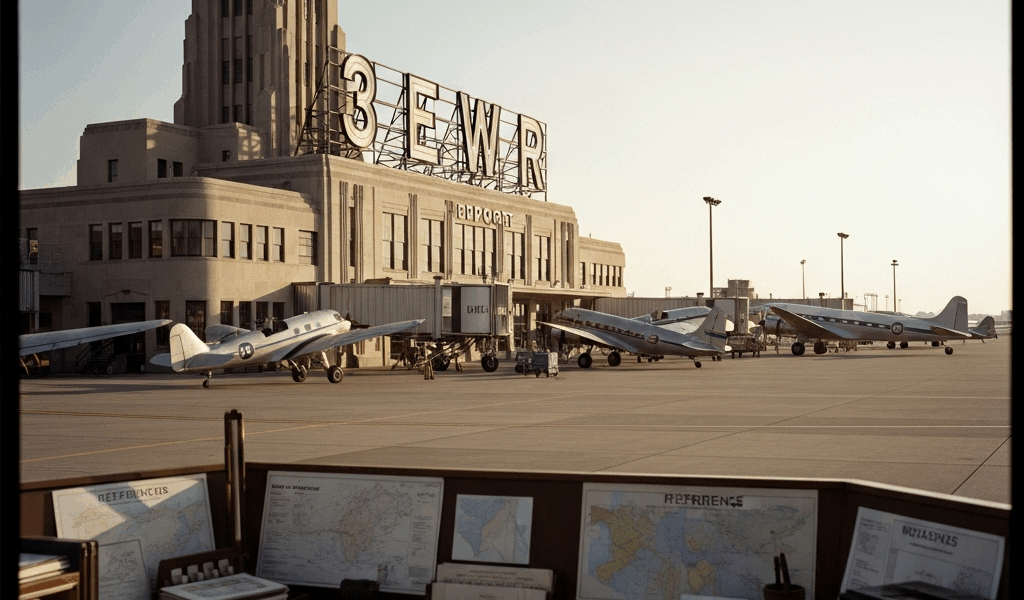
Here’s what most people don’t realize: Newark Airport wasn’t built by the city of Newark or even by New Jersey alone. The Port Authority of New York and New Jersey envisioned this as a major metropolitan facility from the start. Construction kicked off in 1928, and the airport officially opened on October 1, 1930 — making it one of the oldest commercial airports in the United States. At the time, it was actually more modern than LaGuardia.
When the Port Authority was designing the facility and establishing its identity, the three-letter airport code system wasn’t yet formalized into what we know as IATA codes today. The International Air Transport Association didn’t establish its standardized coding system until 1947. Before that? Airlines and airports used various naming conventions. Some codes were straightforward—like DEN for Denver or LAX for Los Angeles. Others followed completely different logic.
The Port Authority made a strategic decision that’s often overlooked: they branded the airport not primarily as “Newark” but as a gateway to the New York metropolitan region. The “EWR” code likely derives from internal Port Authority designations or early aviation nomenclature rather than a direct abbreviation of Newark. Some aviation historians suggest it may have referenced the location’s original designation or a combination system the Port Authority used internally. Honestly, documentation from that era is sparse, and I’ve found competing theories even among airport historians.
What we do know is solid: once the Port Authority settled on EWR in the early 1930s, the code began appearing on flight schedules, routing documents, and operational materials. By the late 1930s and early 1940s, when commercial aviation really expanded, EWR was already embedded in the system. This happened before standardized codes became international law, before computers existed, before any centralized authority could easily change such things retroactively.
Why NWK Was Never Used
You might assume someone would have simply switched to NWK at some point. Probably should have opened with this section, honestly—it explains why code changes are essentially impossible. Once a three-letter airport code becomes operational, changing it isn’t like updating a database field. It ripples through everything.
Consider what would be affected: decades of routing agreements between airlines and airports, international aviation treaties, flight dispatch systems, reservation databases, baggage handling protocols, air traffic control procedures, and countless legal contracts. By the time IATA formally standardized airport codes in 1947, EWR had been in use for roughly 17 years. The code was burned into operational systems that airlines had built around it.
That’s what makes changing an airport code endearing to absolutely nobody in the industry. Every airline would need to update their entire routing system. International agreements with other countries’ aviation authorities would require renegotiation. Air traffic control facilities would need retraining. Insurance documents, leases, contracts—all of it would need amendment or renegotiation. The cost, both financial and operational, would be astronomical.
There’s also the practical matter of transition. You can’t flip a switch and change an airport code overnight. You’d need a lengthy phase-in period where both codes work simultaneously — creating confusion rather than solving it. No airport authority, airline consortium, or government body has ever deemed this worthwhile. I found exactly zero examples of a major commercial airport changing its IATA code after becoming operational. There are no exceptions, no clever workarounds, no historical precedents to follow.
Once the IATA formalized codes in 1947, EWR became locked in stone. Changing it would have required international agreement and coordination among dozens of organizations. The bureaucratic friction alone made it insurmountable.
How EWR Became the New York Metro Standard
Newark Airport didn’t exist in isolation. The New York metropolitan area developed three major commercial airports, and their codes tell an interesting story about airport hierarchy and branding. That’s what makes this history endearing to anyone who pays attention to how these systems actually work.
LaGuardia Airport, which opened in 1939, uses LGA. It was originally called “New York Municipal Airport” but took LaGuardia’s name when Fiorello LaGuardia was mayor — the code stuck straightforwardly. Then there’s JFK International, which opened in 1948 as Idlewild Airport originally assigned IDL. When it was renamed in 1963 after President Kennedy’s assassination, the code changed to JFK. That change happened because the airport was being renamed anyway — making it a unique circumstance.
EWR, by contrast, kept its original code even though the airport served a three-state region and the New York metropolitan area far more than Newark proper. The Port Authority marketed it as “Newark Liberty International Airport” (officially, since 2006), but the code remained unchanged. This actually worked to EWR’s advantage — it gave the airport its own identity separate from the already-crowded Manhattan-centric airports.
By the 1950s and 1960s, as commercial aviation exploded, EWR’s code was simply accepted as standard. Passengers flying through Newark didn’t question it. The code appeared on tickets, signage, and flight information displays so consistently that the disconnect between “Newark” and “EWR” became invisible to most travelers. It was just the code you used when booking a flight to New Jersey.
What EWR Actually Stands For
I spent more time than I should admit trying to find a definitive source for what EWR actually stands for. The Port Authority’s historical records don’t contain an explicit explanation that I could locate. Early aviation documentation uses the code without explanation — no footnotes, no origin story attached.
The most plausible theory involves the airport’s original internal designation. The Port Authority may have used “EWR” as part of a naming convention — possibly derived from geographic coordinates, a company code, or an early aviation standard that predated IATA formalization. Some historians suggest it might reference the airport’s position relative to the Newark waterfront or transportation corridors, though this remains speculative.
What’s certain is that it wasn’t meant to be an obvious “Newark abbreviation.” If it were, we’d expect NWK, which is the logical three-letter reduction. EWR’s origin appears more technical or administrative than phonetic. It’s one of those historical artifacts where the original decision-makers are long gone and the documentation didn’t survive clearly. Don’t make my mistake — don’t assume historical records are thorough or complete.
The honest answer is: nobody knows for certain anymore. But that uncertainty itself is fascinating. An airport code used by millions of people every year, and the origin of those exact three letters is buried somewhere in 1930s Port Authority files or lost to institutional memory. It’s a perfect example of how historical decisions become invisible — so embedded in the infrastructure that nobody remembers why they were made in the first place.
“`


Stay in the loop
Get the latest airport pin updates delivered to your inbox.