Why Is JFK the Airport Code for New York
The JFK airport code question has gotten complicated with all the speculation flying around. Most people assume those three letters connect to geography somehow — maybe a neighborhood abbreviation, maybe something Dutch, maybe a reference to Jamaica Bay right next door. I used to think the same thing. Turns out the real answer is stranger and more specific than any of that, tied directly to one of the worst weeks in American history.
It Did Not Start as JFK
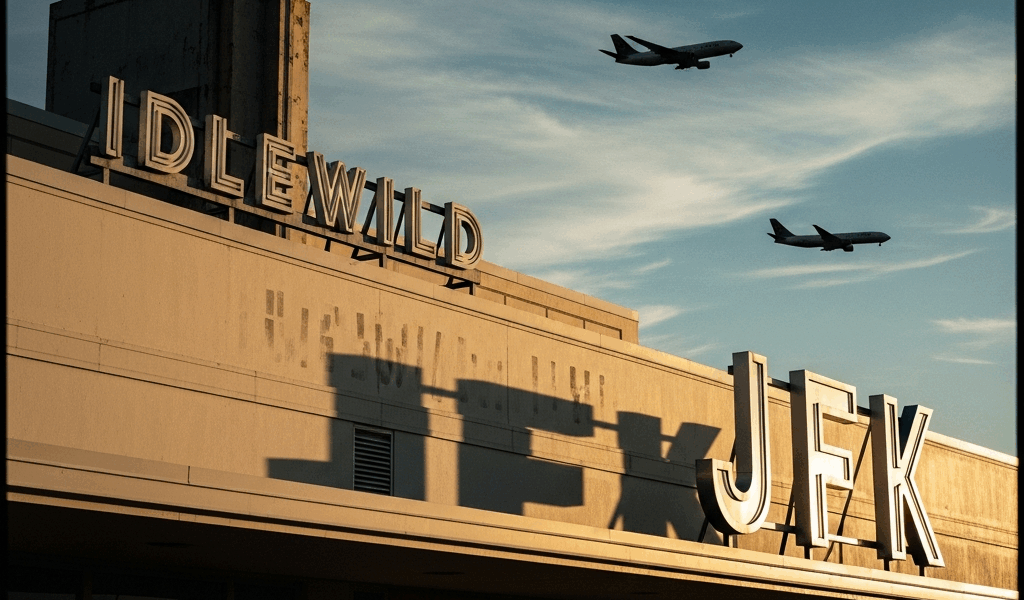
Before the airport was JFK, it was Idlewild. The full name was New York International Airport, Idlewild — borrowed from the Idlewild Golf Course, a modest 1920 facility built on marshy Queens land that nobody had found a better purpose for. The city leveled the golf course in the late 1930s. The airport inherited the name almost by accident.
When IATA started assigning three-letter codes globally, Idlewild got IDL. Made perfect sense. The airport opened commercially in 1948, and IDL showed up on tickets, routing documents, and departure boards throughout the late 1940s and into the 1950s. Book a transatlantic flight from New York back then, and IDL was the code your travel agent typed — probably on a clunky Underwood typewriter, no less.
New York needed Idlewild badly. LaGuardia had opened in 1939 and was already buckling under demand by the mid-1940s. The postwar aviation boom was real, and one airport with limited runway capacity was never going to handle an entire city becoming the center of international commercial flight. So Idlewild was built enormous — roughly 4,900 acres total, one of the biggest airport footprints anywhere in the world at that point. IDL was the code for all of it.
What Changed in November 1963
November 22, 1963. President John F. Kennedy was shot in Dallas. The country went into shock — the kind that doesn’t lift for years, maybe ever.
New York City Mayor Robert F. Wagner Jr. moved fast. On December 4, 1963 — less than two weeks after the assassination — the city officially renamed New York International Airport as John F. Kennedy International Airport. Twelve days. That was the turnaround. It was a direct, public act of grief from the city Kennedy had called home during his Senate years and his presidency.
That renaming is the whole answer to the question. The airport became JFK because John F. Kennedy became the airport’s namesake. IATA retired IDL and issued JFK to match the new official name. No creative wordplay, no geographic logic — just a straightforward lift of the president’s initials.
Probably should have opened with this section, honestly. I’m apparently someone who assumed JFK had always been the code and that IDL was some kind of legacy backup designation. Got it completely backwards. IDL was the original. JFK replaced it. Don’t make my mistake.
Why Three Letters and Not More
But what is an IATA code? In essence, it’s a three-letter global identifier assigned to every commercial airport on the planet. But it’s much more than that — it’s the backbone of baggage routing, ticketing systems, and departure boards worldwide.
Three letters give you 17,576 possible combinations. Enough to cover the world’s airports without duplication, short enough to fit cleanly on a baggage tag. That’s the math behind it. IATA — the International Air Transport Association, a trade body coordinating commercial aviation standards since 1945 — established the system, and it stuck.
JFK is the IATA code. There’s also a separate ICAO code — KJFK, four characters, where the K prefix flags airports in the contiguous United States. Pilots use ICAO. Passengers use IATA. Outside a cockpit, JFK is the designation that matters.
How JFK Became Shorthand for New York Itself
Here is the part that deserves more attention. Airport codes are supposed to be functional identifiers — quiet little abbreviations that live on luggage tags and booking confirmations, recognized mostly by frequent fliers and gate agents. Most of them stay invisible. JFK did not stay invisible.
Stumbling across JFK in film subtitles, news headlines, and song lyrics, you start noticing how often the code substitutes for New York City entirely. A character in a thriller “lands at JFK” — the audience immediately understands. A news headline says the flight departed JFK at 11 p.m. and no further geographic explanation appears anywhere in the story. That’s rare for an airport code. LAX gets close. No other code really competes.
Part of it is sheer volume — JFK handles tens of millions of international passengers annually and has been the primary gateway between the U.S. and Europe for decades. Part of it is the cultural weight those three letters already carried before the airport ever bore them. The two identities reinforced each other. The president’s legacy made the code memorable. The code’s global visibility kept the initials in constant circulation — on a billion boarding passes, endlessly.
Nobody remembers Idlewild the way they remember JFK. IDL is a footnote in aviation history. That was 1948. This is now.
Other Airports Named After Presidents
Renaming airports after political figures is a deeply American habit, and JFK is not the only example worth understanding. The others, though, tell a different story — and that contrast matters.
Reagan Washington National Airport carries the code DCA — District of Columbia Airport, the original name from way back. It was renamed in 1998 to honor President Ronald Reagan, but DCA stayed. The code and the current name share zero letters. That disconnect frustrates people who expect airport codes to be intuitive — and honestly, fair enough.
George Bush Intercontinental Airport in Houston carries IAH — International Airport Houston — renamed in 1997 to honor President George H.W. Bush, a Houston resident, but the IAH code remained untouched. Same pattern as DCA. The renaming happened after the code was already embedded in global routing systems, and changing it would have caused more operational disruption than the symbolism was worth.
JFK is the exception — and that’s what makes it endearing to us aviation history nerds. The renaming happened early enough, just fifteen years into commercial operation, that retiring IDL caused minimal chaos. A fresh code could be issued without breaking anything significant. That window closed fast for most airports. For Idlewild, it happened to stay open.
So, without further ado, the short version: the airport was called Idlewild, coded IDL, renamed for a president twelve days after his assassination in December 1963, and the code changed to match. That’s the whole story. Everything else is details — good details, but details.


Stay in the loop
Get the latest airport pin updates delivered to your inbox.