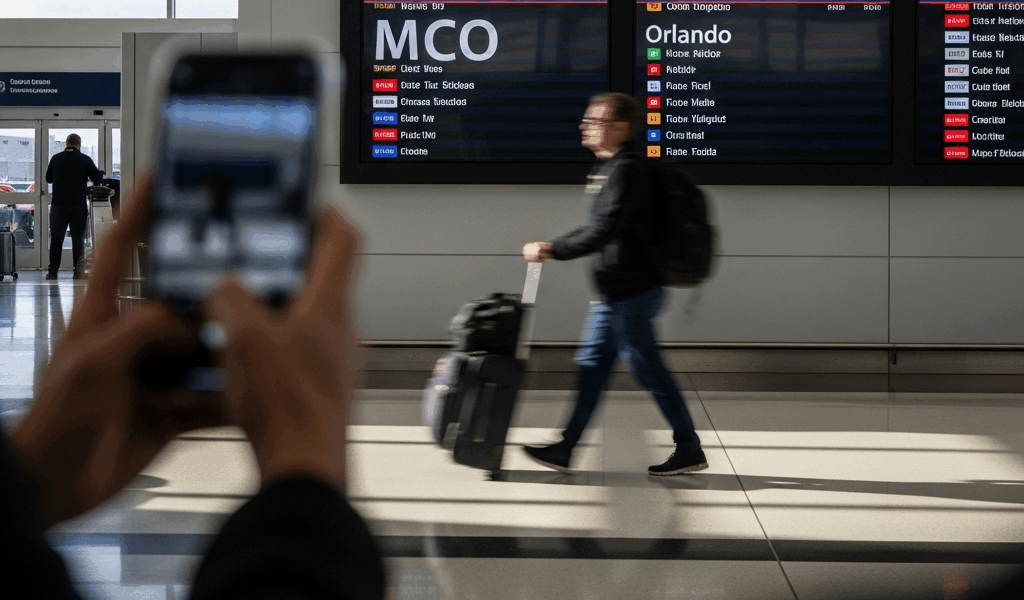
Why Is MCO the Airport Code for Orlando?
The airport code MCO for Orlando baffled me the first time I booked a flight. I typed “Orlando” into the search bar, and up came MCO — no ORL, no ORD, definitely no ORL. Nothing about those three letters screams “central Florida,” “Walt Disney World,” or “the place where I once spent forty-five minutes in a security line behind a family of nine carrying matching roller bags.” It seemed random. It isn’t. The story behind MCO reaches back to the early Cold War, a fatal B-52 crash on a Florida afternoon, and a base commander who died doing something genuinely dangerous at a time when dangerous was the job description. That story deserves more than a trivia answer.
Colonel Michael McCoy — The Name Behind MCO
Intrigued by a throwaway comment from a gate agent in 2019, I went down a research rabbit hole that took me well past midnight and involved three browser tabs of declassified Air Force records. Here is what I found.
Michael Norman West McCoy was a United States Air Force colonel and test pilot stationed at what was then known as Pinecastle Air Force Base, located southeast of Orlando near the community of Taft. He flew the Boeing B-47 Stratojet, a swept-wing, six-engine strategic bomber that represented the leading edge of American air power in the mid-1950s. The B-47 was not forgiving. It was fast, for its era — capable of hitting around 600 miles per hour at altitude — and it demanded precision from pilots who had mostly trained on propeller aircraft with entirely different handling characteristics.
On September 22, 1957, Colonel McCoy was piloting a B-47 on a test flight out of Pinecastle when something went wrong. The aircraft crashed near the base. McCoy did not survive.
He was 37 years old.
The Air Force renamed the installation McCoy Air Force Base in his honor shortly after his death. That naming decision, made in a moment of institutional grief and respect, is the direct reason you see “MCO” printed on your boarding pass when you fly into Orlando. The IATA code didn’t come from a marketing committee or a regional branding exercise. It came from a man who flew experimental aircraft for his country and didn’t come home from one of those flights. Probably should have opened with that detail, honestly — most people who wonder about the MCO code don’t know they’re asking a question with that kind of answer underneath it.
McCoy had served in World War II before transitioning to the jet age. His record reflected the trajectory of American air power itself — propellers to jets, conventional warfare to the nuclear standoff that defined the 1950s and 1960s. By the time he was stationed at Pinecastle, the base had become part of Strategic Air Command, the nuclear-armed bomber force that formed one leg of the U.S. deterrence strategy. The work was consequential. The stakes were not abstract.
From Cold War Air Base to Theme Park Gateway
McCoy Air Force Base spent its operational years as a serious piece of Cold War infrastructure. Strategic Air Command — SAC, as it was universally known — used the base to station long-range bombers capable of reaching Soviet targets. During the Cuban Missile Crisis in October 1962, McCoy AFB was not a peripheral installation. It sat roughly 235 miles from the Cuban coastline. SAC bombers based there were part of the active alert posture during thirteen of the most dangerous days in recorded history.
Think about that geography for a second. The base that would eventually become one of America’s most vacation-oriented airports was, in 1962, hosting nuclear-capable aircraft pointed at Soviet assets in Cuba while Kennedy and Khrushchev negotiated the terms of whether civilization would continue. I find that contrast genuinely difficult to process every time I walk through Terminal B heading toward a Toby Keith’s I Love This Bar & Grill at 7 a.m. before a flight to Newark.
The base operated through the late 1960s and into the early 1970s, but the strategic calculus of American air power was shifting. Intercontinental ballistic missiles made some bomber bases redundant. Base realignment decisions came down from the Pentagon. McCoy Air Force Base closed as an active military installation in 1975.
By that point, the surrounding region had transformed dramatically. Walt Disney World had opened in October 1971 on 27,000 acres of central Florida land that Walt Disney’s team had quietly assembled through a series of shell companies throughout the 1960s. The Magic Kingdom alone drew 10.7 million visitors in its first year of operation. Central Florida needed airport capacity that the older, smaller facilities couldn’t provide.
The conversion of McCoy AFB’s infrastructure into a civilian airport was both practical and rapid. The runways were already built to handle heavy military aircraft — the kind of load-bearing specifications that civilian airport construction would have cost hundreds of millions to replicate from scratch. The physical plant was there. The location, southeast of the city, offered room for expansion. Orlando International Airport opened on the former base property, and it carried the military designation MCO into the civilian aviation system.
My mistake, for years, was assuming that airport codes just reflected city names with minor adjustments. ORD for Chicago O’Hare is another one like MCO — it comes from Orchard Field, the old name before the airport was renamed for a World War II naval aviator, Edward “Butch” O’Hare. Aviation history is full of these embedded memorials. The codes are fossils. They preserve names and places that the signage no longer shows.
MCO in the Age of Disney
Orlando International Airport now handles roughly 50 million passengers per year in normal operating conditions, ranking it consistently among the ten busiest airports in the United States. The airport covers approximately 13,000 acres. It operates four runways. Terminal C, a $2.8 billion expansion project, opened in 2022 to handle the volume that the original terminals could no longer absorb.
None of that infrastructure has anything to do with military aviation. The aircraft parked at its gates are Airbus A320s, Boeing 737 MAXes, and the occasional wide-body international service. The passengers are overwhelmingly leisure travelers — families in matching shirts, solo travelers hauling backpacks loaded with annual pass lanyards, cruise passengers connecting from Port Canaveral.
And yet the code on every ticket, every departure board, every flight tracking app is still MCO.
Changing an IATA airport code is not impossible, but it is genuinely disruptive. Airline reservation systems, printed materials, training manuals, regulatory filings — all of it references the existing code. The cost and friction of switching outweigh the cosmetic benefit of getting something more intuitive, like ORL or OIA. So MCO stays. The code assigned to honor a test pilot killed in 1957 now appears on boarding passes carried by people heading to EPCOT.
There is something I keep coming back to when I think about this. Colonel McCoy flew aircraft that were, by current standards, terrifyingly unforgiving — the B-47 had a documented history of accidents throughout its operational life, with over 200 hull losses recorded across the fleet. Test pilots in that era were not operating with the simulation hours, fly-by-wire safety systems, or ejection seat reliability that modern crews take for granted. They flew on the frontier of what American engineering could build, and some of them didn’t make it back.
The MCO code doesn’t announce any of that. It sits quietly on departure boards between Memphis (MEM) and Milwaukee (MKE), three letters that billions of printed boarding passes have carried without explanation. But now you know what they mean — and why a question about airport code trivia turns out to be a question about the Cold War, a man who died testing a jet aircraft over central Florida, and the strange persistence of names through decades of total transformation.
Next time you land at MCO, you’ll know whose name you just arrived under.

Stay in the loop
Get the latest airport pin updates delivered to your inbox.