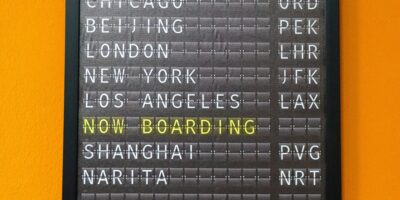
I was sitting at O’Hare last year during a weather delay — one of those situations where nobody knows anything and everyone’s staring at the departure board like it’s going to reveal the meaning of life. And it hit me: those flight information boards are doing way more heavy lifting than anyone gives them credit for. Why do airports use them? Let me break it down, because the reasons go deeper than just showing you a departure time.
Real-Time Information for Thousands of People at Once
This is the obvious one, but it’s worth spelling out. An airport might have tens of thousands of passengers moving through it on a given day, and every single one of them needs to know when and where their flight is leaving. You can’t staff enough people to answer that question individually. You need a system that broadcasts accurate, up-to-the-minute information to everyone simultaneously. That’s what flight information boards — technically called FIDS, for Flight Information Display Systems — do.
The key word there is real-time. When a gate changes, the board updates within seconds. When a delay gets posted, it shows up immediately. Passengers don’t have to find an agent and wait in line to ask what’s happening. They look up, they see it, they adjust. everything else on this list flows from that basic function. If the information isn’t instant and accurate, none of the rest works.
Managing Passenger Flow and Reducing Congestion
Here’s something most travelers don’t think about: FIDS aren’t just informing you, they’re directing you. By showing gate assignments and boarding times, the boards naturally distribute passengers throughout the terminal. People move toward their gate area when they see a gate posted. They head to baggage claim when they see their flight has landed. Without that coordinated information, you’d have crowds of confused people clogging up the same areas, asking the same questions.
Airports actually think about this strategically. The placement of information boards, what info goes on which screens, even the timing of when gate assignments are posted — it’s all managed to keep people moving in an orderly way. It’s crowd management through information design, and it works well enough that most people never realize it’s happening.
Emergency Communication
This one’s less obvious but really important. In an emergency — severe weather, a security incident, a medical situation — airports can use the FIDS network to push emergency messages to every screen in the building. Evacuation instructions, shelter-in-place notices, rerouting information. The infrastructure is already there, already connected, already visible. It doubles as an emergency broadcast system when needed.
I actually experienced this during a tornado warning at DFW once. The screens switched from flight info to shelter directions within seconds. It was — I’ll be honest — a little unsettling to see all that flight data just vanish and be replaced with emergency messaging. But it worked. People moved to interior areas quickly because the instructions were right there on every screen. That’s what makes the FIDS infrastructure important beyond its everyday role — it’s built for the worst days too.
Multilingual Information Delivery
International airports serve passengers from all over the world who speak different languages. FIDS can display information in multiple languages, either by cycling through them on a timed rotation or by using split-screen layouts. This is way more efficient than trying to hire multilingual staff for every information desk — though airports do that too, where they can.
Some airports handle this better than others. I’ve been in terminals where the language rotation was so fast you could barely read it before it switched, and others where it was smooth and well-paced. The good ones use universal symbols alongside text — a plane icon for departures, a suitcase for baggage claim — so even if you miss your language cycle, you can still navigate. Or wait, actually, I think those symbols are standardized across most airports. Regardless, the multilingual capability is a big part of why physical boards remain relevant even in the app era.
The Tech Has Evolved, But the Purpose Hasn’t
The original airport information boards were mechanical — split-flap displays that clicked and clattered as they updated. They were limited in what they could show and slow to change. Modern FIDS use high-resolution LED and LCD screens fed by the airport’s operational database in real time. They can display more flights, more detail, more languages, and update instantly.
But strip away the technology and the core purpose is the same as it was fifty years ago: get the right information to the right people at the right time so flights can operate and passengers can get where they’re going. The delivery method has changed. The underlying need hasn’t.
What About Mobile Apps?
Fair question. If everyone has a phone, why bother with physical boards? A few reasons. Not every passenger has the airline’s app. Not every phone is charged. Not every traveler is tech-savvy. And there’s a shared-awareness thing that phones can’t replicate — when a gate change pops up on the big board, everyone around you sees it at the same time. There’s a collective reaction. With apps, everyone’s in their own little bubble, and you end up with people showing up at the wrong gate because they missed a notification.
Mobile apps are a great supplement. But airports aren’t replacing physical FIDS with them anytime soon, and for good reason. The boards serve a communal function that individual devices simply can’t match. They’re public infrastructure, not personal tools, and that distinction matters more than a lot of people realize.
So the next time you’re standing in a terminal, eyes drifting up to that departure board for the third time in ten minutes — know that it’s not just a screen showing times. It’s a carefully designed system keeping thousands of people informed, moving, and safe. And when it’s working right, you barely even think about it. Which is sort of the whole point.



Stay in the loop
Get the latest airport pin updates delivered to your inbox.