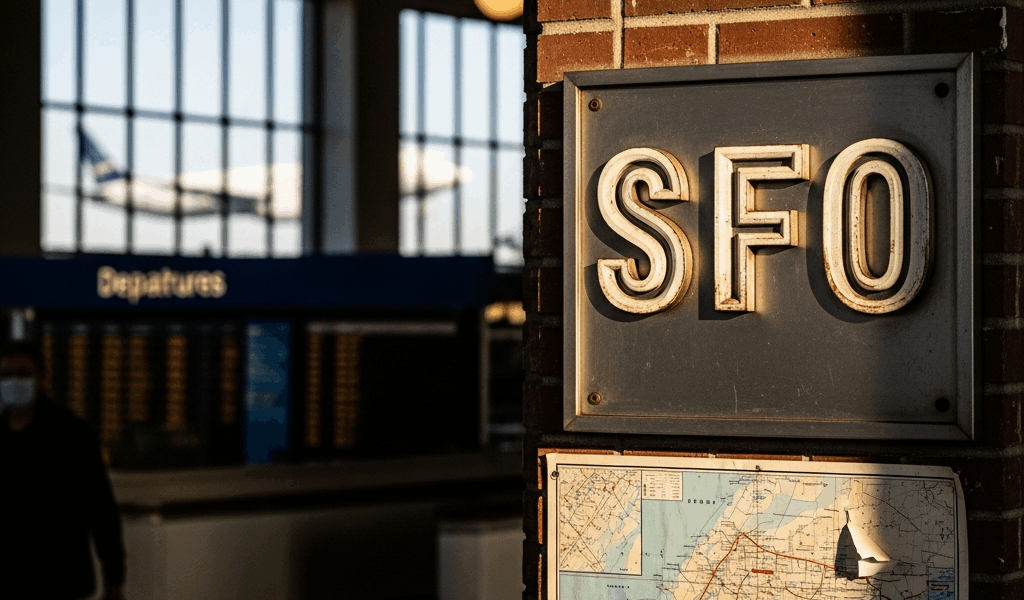
SFO Airport Code Origin — Why San Francisco Uses Three Letters
Airport codes have started getting harder to follow with all the mythology flying around. Everyone has a theory about what the letters mean, where they came from, who decided them. The origin of SFO becomes clearer when it is compared with other Bay Area and U.S. airport codes. The short version: SFO isn’t hiding anything. The letters pull straight from the city name, which makes it one of the more logical codes in the entire American system. But the code itself? Honestly the least interesting part of this airport’s story.
SFO — San Francisco International
But what is an IATA airport code? In essence, it’s a three-letter identifier that routes passengers, luggage, and logistics through a standardized global system. But it’s much more than that — it’s a small piece of aviation history compressed into three characters, and how those characters got chosen tells you a lot about how chaotic early aviation really was.
The three-letter system was formalized in the 1930s. Before that, airports borrowed two-letter National Weather Service station identifiers — functional, but not built for a world where commercial flight was about to explode in scale. The International Air Transport Association pushed for something universal. Three letters, every airport, no exceptions. Many airports just expanded what they already had.
San Francisco did exactly that. The city abbreviation SF, plus an O — which some sources say stood for “Oakland,” others say was just a disambiguating character with no deeper meaning — produced SFO. Apparently there were other SF-prefixed identifiers already floating around, and the O helped keep things clean. Either way, you end up with a code that basically just says what it is. That’s rarer than you’d think.
Compare it to the neighbors. Oakland International is OAK — clean, obvious, no complaints. Then you hit Los Angeles, which uses LAX, where the X is essentially a placeholder that got tacked on when airports had to jump from two letters to three. Chicago O’Hare is ORD because the airport used to sit on a piece of land called Orchard Field. None of that history shows up on a boarding pass. SFO, by contrast, makes sense the moment you look at it. SFO, by contrast, is immediately recognizable as an abbreviation of San Francisco.
The airport itself opened in 1927 — Mills Field Municipal Airport, built on a stretch of Bay mudflats south of the city. It went through several name changes before officially becoming San Francisco International Airport in 1955. The terminal complex most travelers walk through today took shape after a $2.4 billion renovation that stretched across the late 1990s and early 2000s. The International Terminal alone runs roughly 2.7 million square feet of total floor area. Still one of the largest airport terminal buildings in the country.
The Bay Area Airport Trio
Here’s the part worth saying first. For a lot of travelers, the real question isn’t what SFO stands for — it’s which Bay Area airport to actually use. There are three. They serve very different purposes. Picking the wrong one costs you time in ways that don’t become obvious until you’re already stuck in traffic on the 101.
Three major commercial airports serve the greater San Francisco Bay Area.
- SFO — San Francisco International Airport — The largest of the three. United uses it as a hub, and you’ll find Lufthansa, Singapore Airlines, Japan Airlines, and Air Canada all operating flights here. Flying internationally? SFO is almost always your only realistic option among the three. There’s no getting around it.
- OAK — Oakland International Airport — East side of the Bay. Southwest dominates here, which means aggressively priced fares if you’re flexible on timing. BART or a rideshare can get you into San Francisco in 30 to 45 minutes depending on traffic. Parking runs $18 to $22 per day in the economy lots — noticeably cheaper than SFO’s $25 to $28. Underrated airport. Most people overlook it.
- SJC — Norman Y. Mineta San Jose International Airport — Located in San Jose, which puts it closer to the South Bay and Silicon Valley than to San Francisco proper. Alaska and Southwest both have strong presences here. If your destination is Cupertino, Sunnyvale, or Palo Alto, SJC is genuinely worth considering — you skip a lot of Bay traffic that will otherwise eat your afternoon.
Don’t do what I did. I once booked into SFO for a meeting in Mountain View, then sat in 101 traffic for an hour and forty minutes in a rental car that smelled like someone else’s fast food. SJC was right there. I just didn’t think it through. Learned that lesson the expensive, sweaty way — and I haven’t made it since.
For travelers coming from Europe or Asia, SFO is the gateway. For budget domestic flights, OAK earns more credit than it gets. For anyone doing business in the valley, SJC saves time in ways that only become obvious once you’re actually on the ground watching the miles tick by.
Why SFO Is Not Actually in San Francisco
Here’s the part that trips people up — and it tripped me up too, the first time someone pointed it out mid-conversation like it was common knowledge.
San Francisco International Airport is not in San Francisco. It sits in unincorporated San Mateo County, roughly 14 miles south of downtown along the Bay shoreline. Millbrae, San Bruno, Burlingame — these communities frame the airport on its land-side edges. But the airport property itself sits under county jurisdiction, not city limits. San Francisco proper ends well north of the runways.
Unincorporated is the key word. No city actually claims that land. The City and County of San Francisco owns and operates the airport through its Airport Commission — that’s the administrative connection that keeps SF’s name on the door — but the physical location is somewhere else entirely. It’s a political relationship more than a geographic one.
The geography made sense historically. San Francisco is a dense, hilly peninsula. Flat land is scarce. Building a major airport inside the city was never going to work — there simply wasn’t room, and the terrain made excavation a nightmare. The Bay mudflats to the south offered space, even if it required serious land reclamation work. The airport sits on fill and engineered ground — a detail that becomes relevant every time engineers revisit seismic risk assessments for the facilities. Which, apparently, is pretty often.
The BART extension to SFO, which opened in 2003, actually crosses county lines during the trip. It moves through Daly City and South San Francisco before reaching the airport station — a quiet reminder that you’ve been outside San Francisco for a while by the time you arrive.
This new arrangement took off several years later and eventually evolved into the administrative structure enthusiasts of municipal governance know and debate today. But the short version is simple: the code SFO represents the institution and the operator, not the address. Dallas/Fort Worth International sits in Irving, Texas. Same idea — but SFO is one of the more dramatic examples of a city putting its name on an airport that exists somewhere else entirely. The city built it, named it, runs it. The county just happens to be where the runways landed.


Stay in the loop
Get the latest airport pin updates delivered to your inbox.