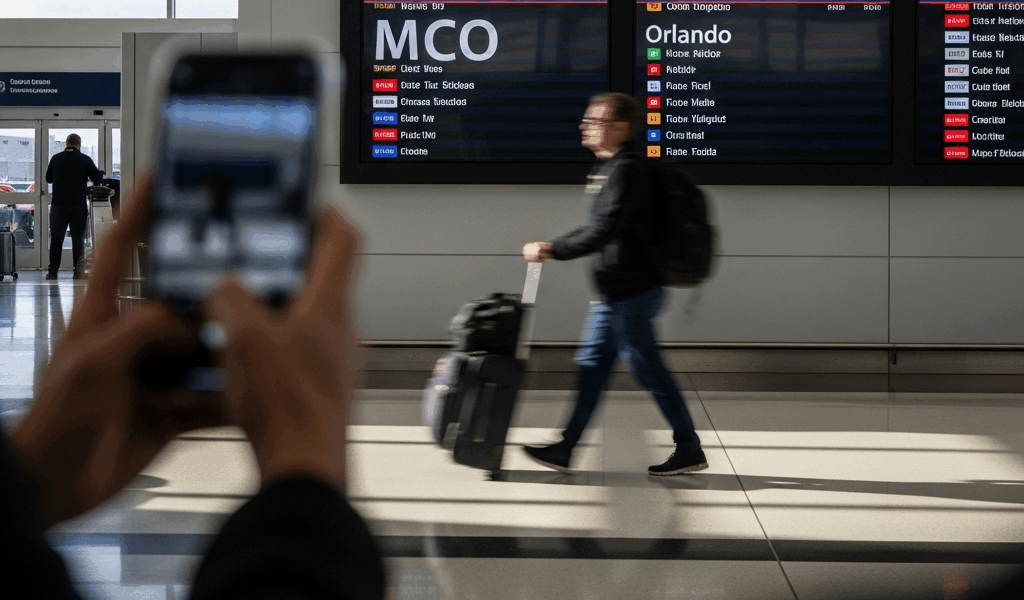
Why Is MCO the Airport Code for Orlando?
Airport codes have started getting harder to follow with all the assumptions flying around — most people figure the letters just abbreviate the city name somehow. Makes sense. Doesn’t hold up. I spent months getting comfortable with MCO after a gate agent in Orlando said something offhand in 2019 that I couldn’t let go of. Typed “Orlando” into a flight search, got MCO back, and thought: that’s wrong. No O, no R, no L in any arrangement that screams central Florida. Definitely nothing that screams “the place where I once spent forty-five minutes in a security line behind a family of nine with matching roller bags.” But it isn’t wrong. It’s just old — and the story underneath it reaches back to the early Cold War, a B-52 crash on a Florida afternoon, and a base commander who died doing something genuinely dangerous at a time when dangerous was basically the job title.
Colonel Michael McCoy — The Name Behind MCO
Worth flagging before going further.
But what is MCO, really? In essence, it’s a military designation that outlived the military installation it came from. But it’s much more than that — it’s a name. Specifically, the name of Colonel Michael Norman West McCoy, a United States Air Force test pilot stationed at what was then called Pinecastle Air Force Base, sitting southeast of Orlando near a small community called Taft.
McCoy flew the Boeing B-47 Stratojet — swept-wing, six engines, capable of around 600 miles per hour at altitude. For the mid-1950s, that was the frontier. The B-47 was not a forgiving aircraft. Most of the pilots climbing into it had trained on propellers, on machines that handled nothing like this. The transition demanded precision that not everyone survived developing.
On September 22, 1957, Colonel McCoy took a B-47 up on a test flight out of Pinecastle. The aircraft crashed near the base. He didn’t come home.
He was 37 years old.
Frustrated by the loss and moved by the instinct toward institutional memory that the military does better than almost anyone, the Air Force renamed the installation McCoy Air Force Base shortly after his death. That decision — made in grief, made fast — is the direct reason you see MCO on your boarding pass today. Not a marketing committee. Not a regional branding exercise. A man who flew experimental jets for his country and didn’t make it back from one of those flights.
McCoy had come up through World War II before transitioning into the jet age — his career basically mirrored the arc of American air power itself. Propellers to jets, conventional warfare to nuclear standoff. By the time he was at Pinecastle, the base had folded into Strategic Air Command, the nuclear-armed bomber force that formed one leg of U.S. deterrence strategy in the 1950s. The stakes were not abstract. Not even a little.
From Cold War Air Base to Theme Park Gateway
McCoy Air Force Base spent its operational years as serious Cold War infrastructure — not a peripheral outpost, but an active SAC installation housing long-range bombers capable of reaching Soviet targets. During the Cuban Missile Crisis in October 1962, the base sat roughly 235 miles from the Cuban coastline. The aircraft stationed there were part of the active alert posture during thirteen days that came genuinely close to ending organized human civilization.
MCO’s code preserves a striking piece of aviation history. The same central Florida site associated with McCoy Air Force Base later became an airport serving millions of Orlando visitors, while the three-letter code continued to reflect the former base name.
The base ran through the late 1960s and into the early 1970s. Then the math changed. Intercontinental ballistic missiles made certain bomber installations redundant — the Pentagon ran the numbers, and McCoy AFB closed as an active military installation in 1975.
By then, central Florida had already transformed into something else entirely. Frustrated by the lack of large-scale theme park options on the East Coast, Walt Disney’s team had spent the 1960s quietly assembling roughly 27,000 acres of Florida land through a web of shell companies — paying farmland prices, keeping the project secret until the purchases were done. Walt Disney World opened in October 1971. The Magic Kingdom alone drew 10.7 million visitors in its first year. Central Florida needed airport capacity it simply didn’t have.
The conversion of McCoy AFB into a civilian airport was, practically speaking, obvious. The runways were already engineered to handle heavy military aircraft — the load-bearing specs alone would have cost hundreds of millions to build from scratch. The location offered room to expand. Orlando International Airport opened on the former base property and carried the military designation MCO straight into the civilian aviation system. No one changed it. The code just stayed.
Skip the misstep I made — I assumed for years that airport codes just reflected city names with minor tweaks. ORD for Chicago O’Hare is another MCO situation: it comes from Orchard Field, the old name before the airport was renamed for Edward “Butch” O’Hare, a World War II naval aviator. Aviation history is full of these embedded memorials. The codes are fossils, essentially. They preserve names the signage stopped showing decades ago.
MCO in the Age of Disney
Orlando International Airport now moves roughly 50 million passengers a year under normal conditions — consistently top ten in the United States by volume. Thirteen thousand acres. Four runways. Terminal C, a $2.8 billion expansion, opened in 2022 because the original terminals hit their ceiling.
None of that infrastructure has anything to do with military aviation anymore. The gates are lined with Airbus A320s and Boeing 737 MAXes. The passengers are overwhelmingly leisure travelers — families in coordinated outfits, solo travelers with annual pass lanyards clipped to their backpacks, cruise passengers connecting down to Port Canaveral.
And every single one of their boarding passes says MCO.
Changing an IATA code isn’t impossible — it’s just disruptive enough that nobody does it without a compelling reason. Airline reservation systems, regulatory filings, training manuals, printed signage across a hundred partner airports — all of it references the existing code. The cost of switching outweighs whatever intuitive clarity you’d gain from something like ORL. So MCO stays. The designation assigned to honor a test pilot killed in 1957 now gets printed on boarding passes carried by people heading to EPCOT for the Food and Wine Festival.
There’s something I keep returning to, honestly. The B-47 that McCoy flew had a documented accident history across its operational life — over 200 hull losses recorded across the entire fleet. Test pilots in that era weren’t working with simulation hours, fly-by-wire safety systems, or ejection seats with anything like modern reliability. They flew on the hard edge of what American engineering could build at that moment, with the understanding that some flights wouldn’t end well. Some didn’t.
The MCO code doesn’t announce any of that. It sits quietly on departure boards between Memphis (MEM) and Milwaukee (MKE) — three letters that have appeared on billions of boarding passes without explanation, carrying a name most travelers have never had reason to look up.
Now you have.
Next time you land at MCO, you’ll know whose name you just arrived under.
Flying to a cruise? Compare MCO with the geographically closer MLB in our guide to the closest airport to Port Canaveral.

Stay in the loop
Get the latest airport pin updates delivered to your inbox.