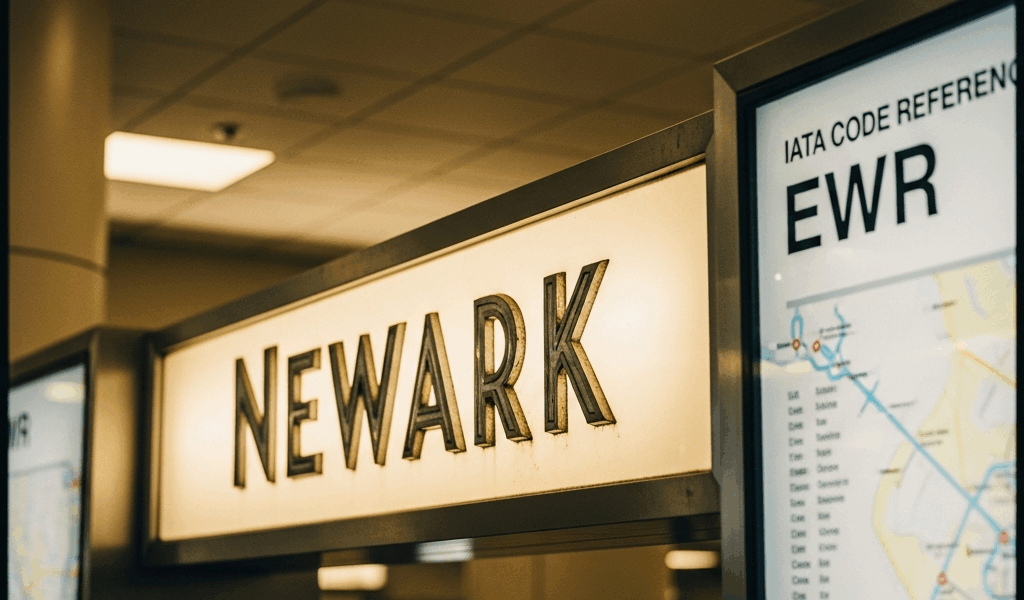
The Short Answer — East Newark
Newark’s airport code has shifted noticeably with all the misinformation flying around. EWR stands for East Newark — and once you see it, you can’t unsee it. I’ve gotten this question probably a dozen times from fellow travelers squinting at their boarding passes, so today I’ll share the working basics of it.
The airport went up on drained marshland along Newark’s northeastern edge — territory that straddled the boundary between Newark proper and the small borough of East Newark. It opened October 1, 1928, operating as Newark Metropolitan Airport. But the geographic marker baked into official records and early air traffic documentation pointed specifically to “East Newark” as the precise location. That E was load-bearing from day one.
IATA codes got standardized through the 1930s and into the 1940s. Newark was genuinely one of the busiest airports in the country during that stretch — the primary gateway for New York air traffic before LaGuardia opened in 1939. By the time any formal code registry existed, EWR was already embedded in airline operations, ticketing ledgers, and routing tables. The name on the sign changed. The code in the system did not. That’s the whole story — except it isn’t, because the more interesting question is why it stayed EWR through every rename that followed.
Why the Code Never Got Updated When the Name Changed
Worth flagging before going further. “East Newark” explaining the E is a fun fact. The reason the code is permanent is the actually useful thing to understand.
Newark Airport has been renamed multiple times. Newark Metropolitan Airport became Newark Airport, then Newark International Airport, then — most dramatically — Newark Liberty International Airport in 2002. That post-9/11 renaming honored the passengers of United Flight 93 who attempted to retake the plane before it crashed in Shanksville, Pennsylvania. Politically significant. Emotionally resonant. Widely covered. EWR didn’t budge by a single letter.
The reason is infrastructure, not sentiment. An IATA airport code isn’t just a label — it’s a primary key in thousands of interconnected databases simultaneously. Change EWR and you’re triggering mandatory updates across:
- Every airline reservation system globally that has ever issued a ticket to or from Newark
- Baggage routing hardware at hundreds of connecting airports
- FAA flight planning and air traffic control documentation
- Travel agency booking platforms, corporate travel management software, and frequent flyer account histories
- Decades of archived ticketing records that need to stay searchable and legally valid
IATA does not reassign active codes. Full stop. They retire codes when airports permanently close and assign new ones when genuinely new airports open on new sites. That’s essentially the entire list. A rename — even one carrying the full weight of a national tragedy — does not meet that threshold. The ghost of “East Newark” will be printed on boarding passes long after every person involved in that 2002 renaming ceremony is gone.
How Airport Codes Were Assigned in the First Place
Early aviation leaned heavily on existing weather reporting infrastructure. The National Weather Service had been using 2-letter station identifiers for decades before commercial aviation needed its own system. When airports required identifiers in the 1930s, the path of least resistance was grabbing those existing 2-letter geographic abbreviations and tacking on a third letter — usually the first available one that didn’t conflict with a nearby location.
For Newark, NE was already spoken for geographically. Nebraska claimed it. The local weather station identifiers in the New Jersey/New York corridor were already crowded, too. The East Newark geographic marker gave them EW, and R completed the three-character code. No committee. No branding exercise. A practical fix to a logistics problem from an era when airlines were still figuring out how to sell tickets by telephone.
Chicago O’Hare is the cleanest parallel. O’Hare’s code is ORD — pulled from Orchard Field, the military airfield converted and renamed to honor Lieutenant Commander Edward “Butch” O’Hare in 1949. Nobody has called it Orchard Field in over 70 years. ORD has never been reconsidered. LAX makes intuitive sense — Los Angeles, X added as a filler with no prior meaning. JFK is a different case entirely, and worth its own section.
Newark vs JFK vs LGA — Why New York Has Three Confusing Codes
Stumped by this cluster the first time I booked flights into the New York area, I ended up landing at EWR and spending 90 minutes getting to Midtown — roughly what I would have spent from JFK. That was a $34 cab fare lesson I only needed once. Side-step the error I made.
LaGuardia is the simple one. LGA opened in 1939, named after Mayor Fiorello La Guardia, and the code reflects the name accurately. No confusion there.
JFK is more interesting. The airport opened in 1948 as Idlewild Airport, running under the code IDL. When it was renamed John F. Kennedy International Airport in 1963 following the assassination, IDL was quietly retired and JFK was assigned fresh — an unusual case where a brand-new code replaced a legacy one. The timing helped. IDL hadn’t been embedded in global systems for decades yet, and the political pressure behind the Kennedy rename was immediate and enormous.
EWR had 30-plus years of operational history by the time any similar pressure could have applied. That’s the difference. That’s what makes airport code inertia so endearing to aviation nerds — the history is baked right in.
Will EWR Ever Change
No.
There’s no realistic mechanism producing a different outcome. Reissuing the code would mean updating systems across every airline, every global distribution system, every travel management platform, and every FAA database simultaneously. A coordinated infrastructure project with costs likely running into hundreds of millions of dollars across the industry — producing exactly zero improvement in the passenger experience. Nobody lands at EWR confused about which airport they’re at. The code works. The name is a ghost.
The 2002 Liberty rename was the highest-pressure test this code will ever face. Politicians, grieving families, national media, a genuine desire to permanently mark a moment of tragedy. None of it was enough to move three letters on a boarding pass. What would be enough? Honestly, nothing short of demolishing the existing facility and opening a replacement on a different site under a different name. Even then — knowing how aviation bureaucracy actually operates — someone would probably try to grandfather EWR into the new build just to avoid the paperwork.
EWR will outlast the airport. It will outlast the airlines that use it. A geographic label from 1928 — East Newark, a name that no longer refers to anything real — turns out to be more permanent than everything that replaced it.


Stay in the loop
Get the latest airport pin updates delivered to your inbox.