The Quick Answer
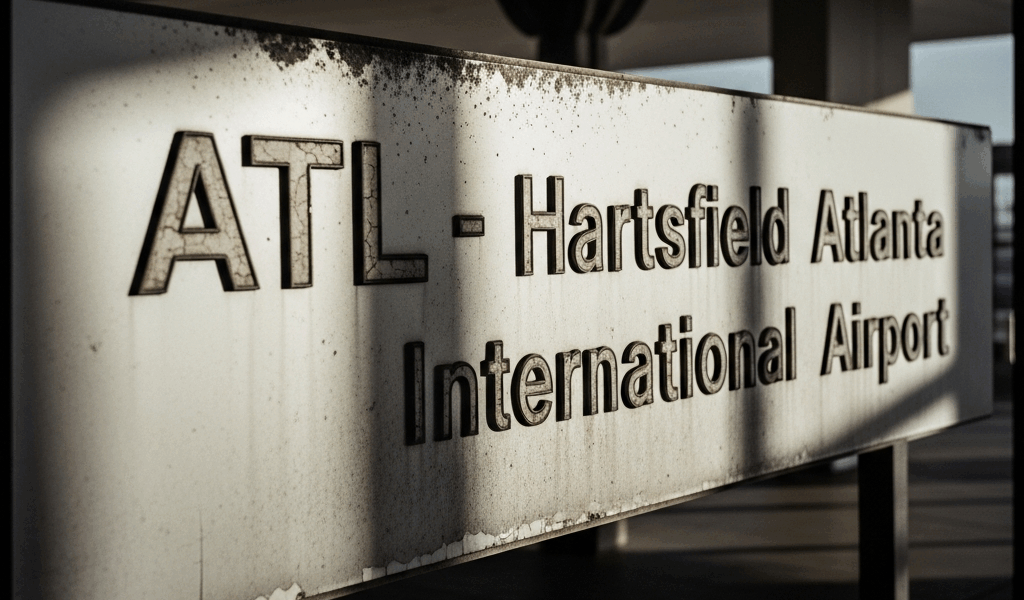
Atlanta’s Hartsfield-Jackson Atlanta International Airport uses the code ATL because that abbreviation comes directly from the airport’s original name—Hartsfield Airport—which opened in 1926. The city officially renamed the facility in 2003 to honor Mayor Maynard Jackson alongside founder William B. Hartsfield, but the IATA code stayed locked at ATL. Despite the official name change nearly two decades ago, if you book a flight, check baggage tags, or glance at airport signage, you’ll see ATL, not ATH or any other variation.
The real story here involves airport code logic — it’s not as simple as “use the current official name.” Early airport codes were assigned based on founder names, local landmarks, or whatever seemed logical at the time. And once a code embedded itself into global systems? Changing it became a logistical nightmare. ATL stuck because Hartsfield stuck. Hartsfield stuck because one man shaped an entire city’s aviation future.
Why Hartsfield Dominated the Code
William B. Hartsfield served as Atlanta’s mayor from 1937 to 1962 — longer than most people stay in their jobs — and he became obsessed with making Atlanta a major aviation hub. At the time, that was an unusual priority for a southern city. But Hartsfield saw airports as the future of commerce and connectivity.
The original airport, which opened in 1926, was actually called Candler Field, named after the Coca-Cola heir Asa Griggs Candler. When Hartsfield pushed through a massive expansion and modernization effort in the 1930s and 1940s, the city renamed it Hartsfield Airport in his honor — a common practice for recognizing leaders who championed infrastructure. This happened in 1971, though Hartsfield had already retired as mayor by then.
The abbreviation ATL emerged naturally from “Hartsfield Atlanta.” Early airport codes weren’t standardized the way you might think. Some codes came from city names (MIA = Miami, DFW = Dallas-Fort Worth). Others came from founder names or nicknames. Some just came from whatever three letters people started using on luggage tags and boarding passes. ATL became shorthand for the airport because it referenced both the original namesake and the city. It was clean, memorable, and unique. Once airlines printed thousands of tickets with ATL, once baggage systems worldwide registered ATL in their databases, once pilots filed flight plans using ATL — changing it would have created absolute chaos.
Hartsfield himself died in 1971, around the time the airport formally took his name. But his legacy had already cemented itself into the airport code. The man who built Atlanta’s airport empire had earned that recognition permanently.
The 2003 Renaming and Why ATL Stayed
Here’s where things get interesting. In 2003, Atlanta’s city government decided to honor another transformative mayor — Maynard Jackson — by renaming the facility to Hartsfield-Jackson Atlanta International Airport. Jackson served as mayor from 1974 to 1982 and again from 1990 to 1994, and he pushed through major expansions of the very airport that Hartsfield had started. Both men shaped Atlanta’s aviation destiny, so combining their names made political and historical sense.
But the IATA code — the three-letter designation used by every airline, airport system, and booking platform globally — remained ATL.
This makes people furious when they first learn about it. “But the official name includes Jackson now,” they think. “Shouldn’t it be ATH or ATJAX or something?” The answer is no. And I get why people ask.
Probably should have opened with this section, honestly. This is the practical meat of why airport codes stick around like old tattoos.
An airport code isn’t just cosmetic. It’s wired into systems that process millions of transactions daily. Airlines use IATA codes in their reservation software, ticketing platforms, and crew scheduling systems. Ground handling equipment is labeled with codes. Baggage sorting systems route bags based on these three letters. Air traffic control uses them. Every hotel booking system, rental car company, and travel website indexes flights by IATA code. The FAA, ICAO (International Civil Aviation Organization), and dozens of international aviation bodies maintain registries tied to these codes.
Changing ATL to something else would require coordination across hundreds of airlines, software vendors, government agencies, and service providers. The financial cost would be staggering — updating systems, reprinting signage, retraining staff, managing the transition period when old and new codes might both appear in systems. During that chaotic window, flights might get misdirected, bags lost, bookings confused. For a passenger, “my flight is on American 447 to ATL” suddenly becomes “actually it’s ATH now,” and you’ve created a month of customer service nightmare calls.
For a thriving airport — and ATL is the world’s busiest by passenger traffic, handling over 100 million passengers annually — that risk is unacceptable. The code works. Everyone knows ATL. Changing it benefits no one except those who prefer perfect name-code alignment, which isn’t a real operational benefit.
So even though the official legal name changed in 2003, the code stayed frozen in place. ATL had achieved a kind of permanence. And frankly, the name change worked fine without touching the code — the airport simply added “Hartsfield-Jackson” to all official communications while keeping ATL humming through every system that matters.
How ATL Compares to Other Renamed Airports
ATL is not completely unique in this situation. But the handling differs by airport.
JFK Airport in New York presents the opposite scenario. It was originally Idlewild Airport until 1963, when it was renamed John F. Kennedy International Airport following his assassination. The code changed from IDL to JFK. This worked because the renaming happened early in the jet age when systems were less globally interconnected and less rigid. Fewer airlines. Fewer baggage systems. Fewer countries involved in the coordination. The transition was still painful but manageable.
Hartsfield had already been operating under the ATL code for decades by 2003. The infrastructure was exponentially more complex. Changing it would have been infinitely harder than what happened in 1963.
Hong Kong’s major airport was called Kai Tak until 1998, when it moved to a new facility called Hong Kong International Airport. The code stayed HKG because the new airport inherited the old airport’s code. The official name changed, but the code’s continuity was preserved intentionally.
These examples show a pattern: airport codes are sticky by design. They’re meant to be permanent identifiers, not subject to political or commemorative whims. ATL reflects this principle perfectly. The code represents the airport’s identity in global systems, separate from whatever names the city decides to give it.
Why This Matters to Travelers
If you’re booking a flight through Atlanta, you’re searching for ATL. Every booking confirmation says ATL. Your boarding pass says ATL. The overhead signs at the airport — both inside terminals and on highway directions — display ATL prominently. You could stand in the middle of Hartsfield-Jackson Atlanta International Airport reading the official name on the wall, then look at your ticket and see ATL, and never feel confused because both are simultaneously true.
The code matters in practical ways. It’s how airlines organize operations, how Google Flights filters results, how your phone maps the airport on a connecting flight. It’s the code you’d use if you called the airport directly or looked it up in an aviation database. Stability in that code means reliability in your travel plans.
This also explains why airport names get weird. Cities name them for mayors, politicians, military figures, or local heroes. But codes lock in place based on historical momentum. You end up with situations like this — the official name and the code don’t align anymore, but changing either one now would cause more problems than it solves.
The bottom line: ATL will never change. Hartsfield-Jackson Atlanta International Airport will always use ATL. The city could rename it again fifty years from now, add more names, reorganize entirely — and ATL would still be the code. That’s how aviation infrastructure works. Names are flexible. Codes are permanent. Hartsfield’s legacy, encoded as three letters in systems worldwide, remains fixed even as his successors get commemorated alongside him in the official title.




Stay in the loop
Get the latest airport pin updates delivered to your inbox.