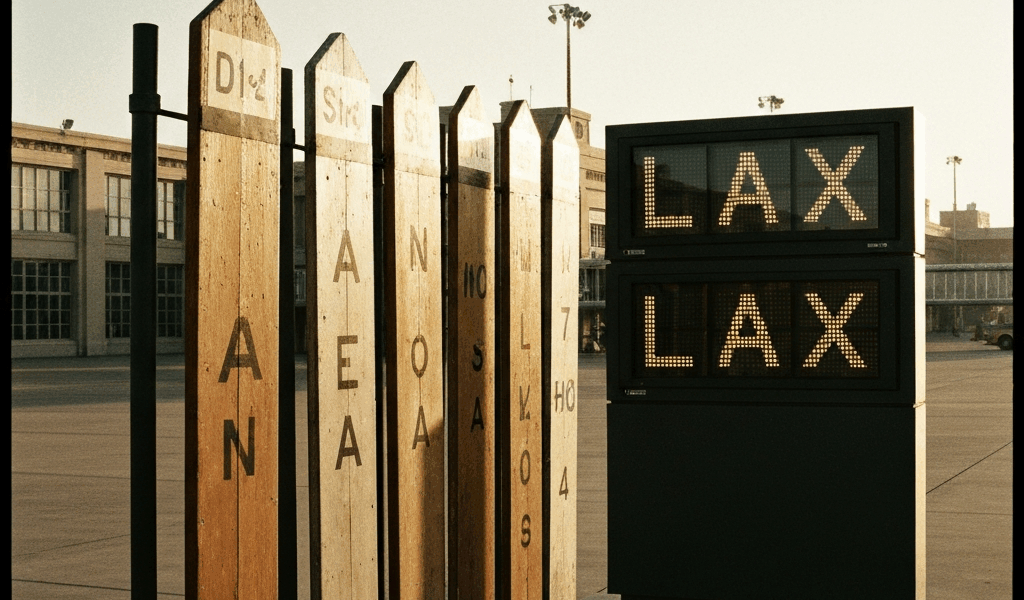
The Short Answer — Why LAX Isn’t Just LA
Los Angeles International Airport uses LAX instead of LA because IATA — the International Air Transport Association — requires all commercial airport codes to follow a three-letter system. LA alone wouldn’t work. Two letters simply aren’t enough for a global aviation network processing hundreds of thousands of flights daily. The X was deliberately chosen to create a unique identifier that distinguished Los Angeles International from every other potential LA entity — whether that’s other airports, cities, or regional designations. When you’re managing millions of passengers annually at one of the world’s busiest airports, ambiguity kills efficiency. That’s what makes the three-letter standard so critical to modern aviation.
How IATA Airport Codes Actually Work
Before we get into why LAX specifically matters, you need to understand the system itself. The IATA three-letter code standard emerged because commercial aviation exploded in the mid-20th century. Airlines needed standardized, globally recognized identifiers that worked across countries, languages, and ticketing systems. A pilot couldn’t book a flight to “LA” — too vague, too many possibilities, too many mistakes waiting to happen.
Three letters solve this problem elegantly. They’re memorable. They’re unique. They’re short enough for signage, ticket printing, and verbal communication without becoming unwieldy. When you announce “Passengers for New York, please proceed to gate 47,” nobody knows which New York airport you mean. But say “JFK” and everyone understands immediately. That distinction matters.
Look at how other major metropolitan areas handle multiple airports. New York City has three major commercial airports: JFK (John F. Kennedy International), LGA (LaGuardia), and EWR (Newark Liberty International). San Francisco Bay Area spreads across SFO (San Francisco International), OAK (Oakland International), and SJC (San Jose Mineta International). Without these distinct codes, ground operations and ticketing systems would collapse.
The system works because it’s rigid. Every commercial airport worldwide follows this framework. You can’t negotiate. You can’t ask IATA for a two-letter exception. Three letters. That’s the requirement.
The History of Los Angeles International Airport’s Code
Los Angeles International Airport opened in 1949 as a municipal facility on former agricultural land in Inglewood — about 15 miles south of downtown Los Angeles. Initially, the airport used the code “LA” informally. But as commercial aviation expanded through the 1950s and IATA formalized its coding system, the airport needed a proper three-letter designation.
The X in LAX wasn’t arbitrary. It came from Los Angeles’ original geographic designation, though documentation varies on the exact reasoning. What matters is that LAX became the official code when IATA standardized operations in the mid-1950s. The airport was growing rapidly — international routes launching, passenger volume climbing, the aviation industry demanding clear, unambiguous codes.
By the 1960s, LAX was handling millions of passengers annually. The code stuck. It became synonymous with the airport itself. Marketing teams, airlines using LAX as a hub, travelers — everyone reinforced the code until LAX transformed from a technical designation into a cultural identifier. You don’t see JFK referred to as simply “New York.” You don’t see SFO called “San Francisco.” LAX has transcended its technical function entirely.
The airport continued expanding dramatically. In 1961, the iconic Theme Building opened — a futuristic structure that became LAX’s visual symbol. Terminal after terminal was added throughout the 1960s and 1970s. By the 1980s, LAX had become one of the world’s busiest international gateways. The code LAX was already fully embedded in global consciousness. Probably should have opened with this section, honestly.
Why Not Just Use LA for Los Angeles
This question reveals the core problem the X solves. Los Angeles isn’t just an airport. It’s a massive metropolitan area with multiple aviation facilities, each serving different purposes.
Beyond Los Angeles International, Southern California hosts Long Beach Airport (LGB), Burbank Airport (BUR), Ontario International (ONT), and Santa Ana’s John Wayne Airport (SNA). Each serves specific markets — Burbank historically handled domestic flights, Long Beach focuses on low-cost carriers, Ontario serves inland cargo and charters. If the region’s primary airport used “LA,” travelers couldn’t distinguish which airport they were flying into. Ground crews couldn’t route cargo correctly. Airlines couldn’t manage schedules without confusion creeping in.
There’s also the military dimension. The U.S. Air Force operates bases and facilities across Southern California. Civilian airports can’t claim two-letter codes that might conflict with military designations or existing protocols. The three-letter system creates separation and clarity — it’s deliberate architecture.
Beyond Southern California, “LA” carries multiple meanings. It’s used for Laredo, Texas. It’s the state abbreviation for Louisiana. It’s used in countless city names globally. A two-letter airport code would create jurisdictional nightmares in international aviation databases. Every booking system, every airline’s reservations software, every baggage handling system relies on unique three-letter codes to function without errors. The X wasn’t a compromise. It was the solution that made the entire system work.
LAX Code Recognition and Global Impact
Here’s where LAX transcends its technical purpose entirely. The code became iconic. You see it on merchandise. Athletes wear LAX apparel as shorthand for representing Los Angeles. Movies reference LAX in dialogue without explanation — screenwriters assume audiences recognize it immediately. That’s genuinely rare for an airport code.
The code’s recognition stems from practical factors. LAX is one of the world’s busiest airports, handling 80-90 million passengers annually and consistently ranking in the top five globally. More people move through LAX than most major cities’ total population. When millions of passengers use an airport yearly, its code enters collective consciousness through sheer volume.
Airlines reinforced this recognition relentlessly. American Airlines, which historically dominated LAX operations, printed LAX on every ticket, every baggage tag, every gate sign. Qantas, British Airways, Japan Airlines — every major carrier using LAX as a hub integrated the code into their branding and operations. Passengers learned LAX meant a major international gateway with reliable connections. That messaging stuck.
The airport’s location amplified everything. Los Angeles is an entertainment industry capital. The airport became featured in countless films and television shows. Every movie scene showing planes or airport operations featured LAX signage prominently. The code became visually associated with glamour, travel, and international destinations in ways other airport codes simply weren’t.
Pop culture embraced LAX differently than other airport codes. You rarely hear SFO or DEN mentioned casually in conversation. But LAX appears in songs, television pilots set in Los Angeles, and casual references throughout American media. The X makes it distinctive — memorable in a way that three-letter codes usually aren’t.
The code also benefited from technical simplicity. LAX is easy to say in multiple languages. The X sound translates cleanly across English, Spanish, Mandarin, and Japanese. Ground crews at international airlines could call out “LAX” without accent issues or phonetic confusion. That clarity helped cement the code in global aviation operations more than you’d expect.
Modern technology reinforced LAX’s dominance further. When digital booking systems emerged, LAX’s three-letter code became the standard field length across every airline’s database. Mobile apps, airport websites, flight tracking services — all built around three-letter codes. LAX wasn’t just accepted; it became the structural foundation supporting how modern travelers interact with aviation itself.
The code’s success created a self-reinforcing cycle. Because LAX was widely recognized, airlines invested more heavily in operations there. Because more airlines operated at LAX, passenger volume increased. Because passenger volume was enormous, the code achieved even greater cultural penetration. LAX didn’t just represent an airport — it became a symbol of Los Angeles itself. Today, LAX is arguably the most recognized airport code globally. Travelers from Tokyo to São Paulo to London recognize LAX immediately.


Stay in the loop
Get the latest airport pin updates delivered to your inbox.