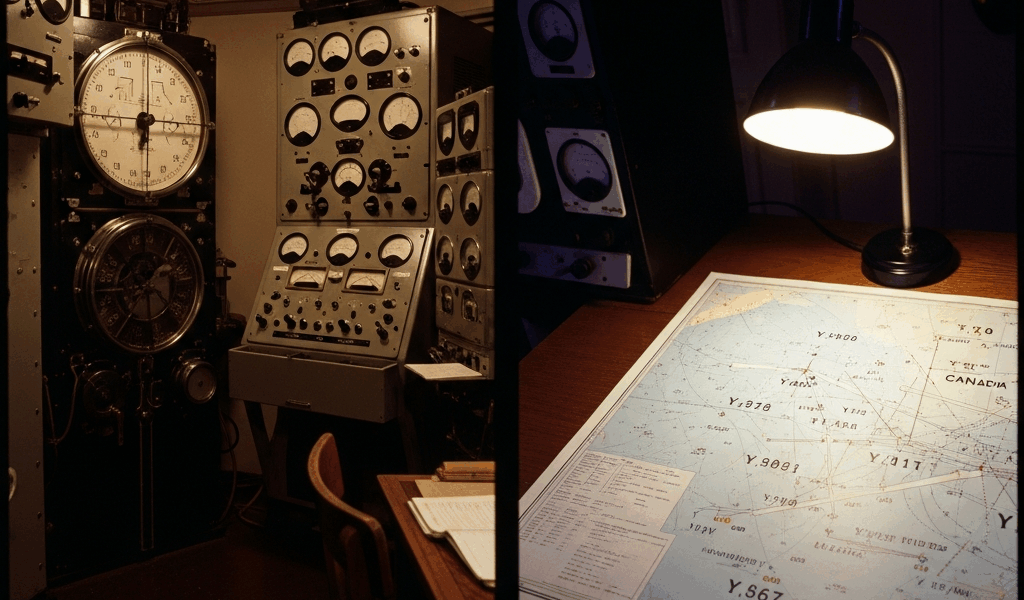
Many Canadian airport codes begin with Y because of a convention dating to the pre-World War II era. IATA says the pattern is believed to be related to older two-letter identifiers used for weather stations or radio-location beacons. When three-letter location codes developed, many Canadian locations retained that Y-based legacy.
Two cautions matter. First, IATA describes the historical origin as a belief, not a fully documented universal formula. Second, not every Canadian airport code begins with Y, and IATA says the convention is no longer applied automatically.
Why Canadian Codes Often Start With Y
Before modern airline reservation systems, aviation relied heavily on weather reports and radio navigation. Canadian weather stations and radio beacons used compact identifiers. IATA’s official location-code fact sheet says the familiar Y pattern dates to that prewar environment and is believed to be related to those two-letter identifiers.
That is more precise than saying “Y means Canada” or that the government simply added Y to every railway code. Y is not an IATA country prefix, and official sources do not provide a single letter-by-letter decoding rule for all Canadian airports.
Do All Canadian Airport Codes Begin With Y?
No. The pattern is extremely common at major Canadian passenger airports—YYZ Toronto Pearson, YVR Vancouver, YYC Calgary, YUL Montréal-Trudeau, YOW Ottawa and YWG Winnipeg—but it is not universal. IATA explicitly says the convention is no longer automatically observed.
Examples of Canadian IATA codes that do not start with Y include ZBF for Bathurst and ZUM for Churchill Falls. Some small aerodromes have no IATA code at all and use another identifier system. Therefore, a leading Y is a useful clue, not proof that a code is Canadian.
Common Canadian IATA Airport Codes
| IATA code | Airport | City/region |
|---|---|---|
| YYZ | Toronto Pearson International | Toronto, Ontario |
| YTZ | Billy Bishop Toronto City | Toronto, Ontario |
| YVR | Vancouver International | Vancouver, British Columbia |
| YYC | Calgary International | Calgary, Alberta |
| YEG | Edmonton International | Edmonton, Alberta |
| YUL | Montréal-Pierre Elliott Trudeau International | Montréal, Quebec |
| YOW | Ottawa Macdonald-Cartier International | Ottawa, Ontario |
| YWG | Winnipeg James Armstrong Richardson International | Winnipeg, Manitoba |
| YHZ | Halifax Stanfield International | Halifax, Nova Scotia |
Use an official IATA lookup or the airport/operator site rather than trying to reverse-engineer the second and third letters. Claims such as “V means Vancouver and R means radio” often sound plausible but are not a dependable coding rule.
IATA Codes Are Not ICAO Location Indicators
IATA codes have three characters and support passenger and commercial systems such as reservations, schedules, tickets and baggage. ICAO location indicators have four letters and are used in operational aviation references.
| Airport | IATA | ICAO |
|---|---|---|
| Toronto Pearson | YYZ | CYYZ |
| Vancouver International | YVR | CYVR |
| Calgary International | YYC | CYYC |
| Montréal-Trudeau | YUL | CYUL |
It may look as if ICAO merely adds C to every Canadian IATA code, and many major examples do align that way. Do not treat that as a universal conversion algorithm. Look up the official identifier because the systems have different assignment rules and purposes.
Why the Codes Rarely Change
IATA says assigned three-letter location codes are considered permanent and are almost never changed, except with strong justification primarily related to air safety. Stability matters because codes are embedded in reservations, fares, schedules, baggage handling, cargo systems and historical records.
That is why a code can survive an airport rename. Toronto’s airport changed from Malton Airport to Toronto International and later Toronto Pearson, but YYZ remained. Read the documented case study in why Toronto Pearson uses YYZ rather than TOR.
What About Canadian City Codes?
An IATA metropolitan code can represent a city served by multiple airports. YTO represents the Toronto area, while YYZ identifies Pearson and YTZ identifies Billy Bishop. Searching YTO may return more than one airport; putting YYZ on a baggage tag or itinerary means Pearson specifically.
Quick Answers
- Why do Canadian airport codes start with Y? Many reflect a prewar convention believed to derive from weather-station or radio-beacon identifiers.
- Does Y officially mean Canada? No. It is a historical pattern, not an IATA country-prefix rule.
- Do all Canadian codes start with Y? No.
- Can you decode the other two letters? Not reliably with one universal rule; use an official lookup.
- Why keep confusing codes? IATA codes are designed to remain stable and rarely change.



Stay in the loop
Get the latest airport pin updates delivered to your inbox.