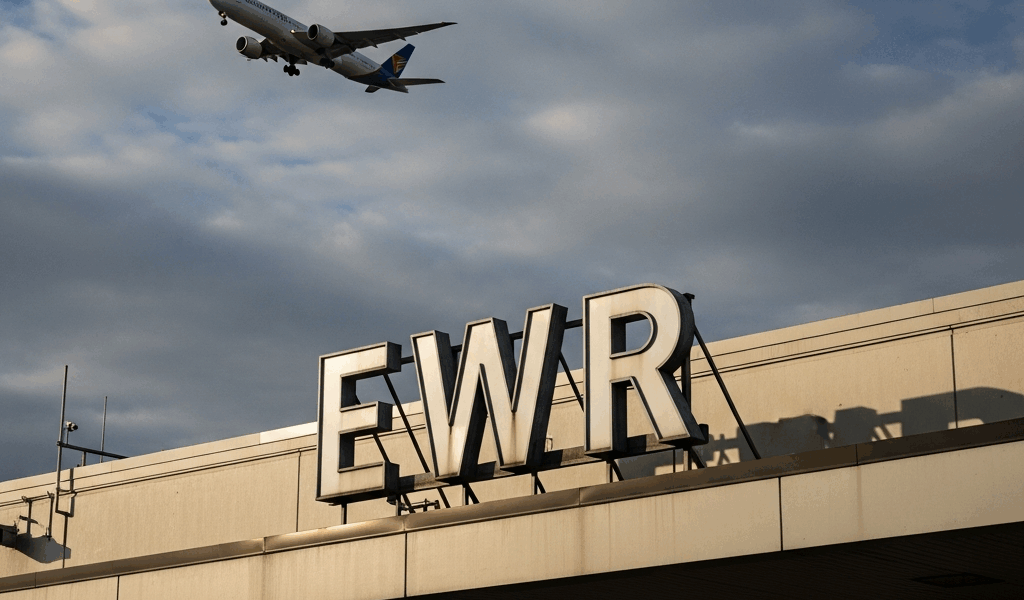
Why Is EWR the Airport Code for Newark? The Real Story
The question of why EWR is the airport code for Newark has genuinely stumped me at a gate more than once. I’m the kind of person who will stand in a terminal, boarding pass in hand, staring at a three-letter code like it personally offended me. EWR doesn’t exactly scream Newark. It doesn’t scream anything, honestly. But once you understand the full story behind how the New York metro area divided up its airport codes, EWR becomes not just logical — it becomes kind of brilliant in a weird, constrained, making-the-best-of-a-bad-situation way.
The NYC Airport Code Battle
New York City is served by three major airports: John F. Kennedy International (JFK), LaGuardia (LGA), and Newark Liberty International (EWR). That last one sits just across the state line in New Jersey, but it’s absolutely part of the New York metro aviation ecosystem. The Port Authority of New York and New Jersey operates all three. They share the same general airspace, compete for the same passengers, and appear together on every comparison chart when people are deciding how to get in and out of the city.
Here’s where the code story gets interesting. When IATA — the International Air Transport Association — began formalizing airport codes, the system had a loose early logic where single-letter or short codes were assigned based on city names or radio beacon identifiers. N, logically, should belong to New York. Newark could have grabbed NE or NEW pretty reasonably. Neither of those things happened, and the reason is timing and turf.
The letter N was already claimed. In aviation, N is the country prefix for the United States in aircraft registration — every American-registered plane starts with N. That alone created complications. Beyond that, the broader New York metro designation effectively locked up the obvious short options. JFK used to be called Idlewild, and its code was IDL. When it was renamed in 1963 after President Kennedy’s assassination, the airport got a fresh code — JFK — which was a clean, obvious tribute. LaGuardia grabbed LGA from the city’s longtime mayor Fiorello La Guardia, who championed the airport’s construction in the 1930s. Both of those are straightforward.
Newark was the odd one out. By the time codes were being standardized more rigorously, the obvious single-letter N and the intuitive three-letter NEW were either spoken for or too ambiguous in the context of the entire New York system. So the people assigning codes did something clever: they went fishing inside the word itself.
EWR — Hidden in nEWaRk
Look at the city name. N-E-W-A-R-K. Pull out the second, third, and fifth letters — E, W, R — and you have EWR. That’s it. That’s the whole trick. Confused by this for years, I finally looked it up properly during a four-hour delay at Terminal C, sitting next to a guy eating what I can only describe as the world’s saddest $19 airport sandwich. Moment of clarity, terrible circumstances.
It’s not the first time a city’s code was extracted this way rather than taken from the front of the name. ABQ for Albuquerque is another example — you won’t find those three letters sitting neatly at the start. ORD for Chicago O’Hare comes from Orchard Field, the airport’s original name. Airports collect these historical accidents like barnacles. But EWR stands out because the source city name is short and common, and the code still manages to feel non-obvious.
This is genuinely why travelers get confused. If you book a flight and it says EWR, and you’re not a frequent flier or an aviation nerd, your first instinct is not Newark, New Jersey. Your instinct might be to Google it, or worse, assume it’s some regional airport you’ve never heard of. I’ve seen people in line at check-in genuinely surprised to learn they’re flying into New Jersey rather than into one of the Manhattan-adjacent airports. The code does Newark no favors in terms of instant recognition.
Probably should have opened with this section, honestly, because the code extraction trick is really the core of the whole story. Everything else is context.
A Quick Look at How Other Extracted Codes Work
- ABQ — AlBuQuerque, New Mexico
- ORD — Chicago O’Hare, from its original name, Orchard Field
- EWR — nEWaRk, New Jersey
- MSY — New Orleans, from Moisant Stock Yards, the land the airport was built on
- YYZ — Toronto Pearson, from an old railway station code
Each of these tells a story about what the airport used to be, or what the naming authorities had available when the code got locked in. Aviation codes are frozen history. Once assigned and in use, changing them is a logistical nightmare that touches every booking system, departure board, and flight tag printer on earth.
The Busiest Airport System in the US
The New York metro airport system — JFK, LGA, and EWR taken together — handles more total passengers than any other metro area in the United States. According to Port Authority data, the three airports combined process somewhere north of 130 million passengers annually in strong travel years, though COVID-era dips knocked those numbers around between 2020 and 2022. They’ve been climbing back steadily.
Each airport carved out a functional niche over the decades. LaGuardia became the short-haul domestic hub — it’s physically small, constrained on all sides by water and infrastructure, and until a recent renovation that cost roughly $8 billion, it had a justified reputation as one of the most miserable terminal experiences in the country. JFK is the international gateway, the long-haul behemoth, the place where you land after crossing an ocean and spend forty-five minutes in customs. Newark became the third option, slightly less crowded, farther from Manhattan by road but accessible via the AirTrain to Newark Penn Station and then NJ Transit into the city — a trip that can run around $15 to $18 depending on your rail ticket and connection.
Stranded by a flight cancellation at EWR in 2018, I learned the hard way that the AirTrain stops running at certain overnight hours, which is information that would have been extremely useful before I bought a $67 rideshare back to Brooklyn at 1 a.m. The lesson: always check ground transport schedules before you assume the train will be there.
Newark actually has a legitimate claim to being the oldest major commercial airport in the region. Newark Airport opened in 1928, predating both LaGuardia (1939) and what became JFK (1948). It was, for a stretch, the busiest airport in the world. The code EWR now carries that history inside it — a city name, compressed and reshuffled, stamped on flight tags and departure boards and confused Google searches everywhere United Airlines flies.
Three letters. Hidden in plain sight the whole time.

Stay in the loop
Get the latest airport pin updates delivered to your inbox.