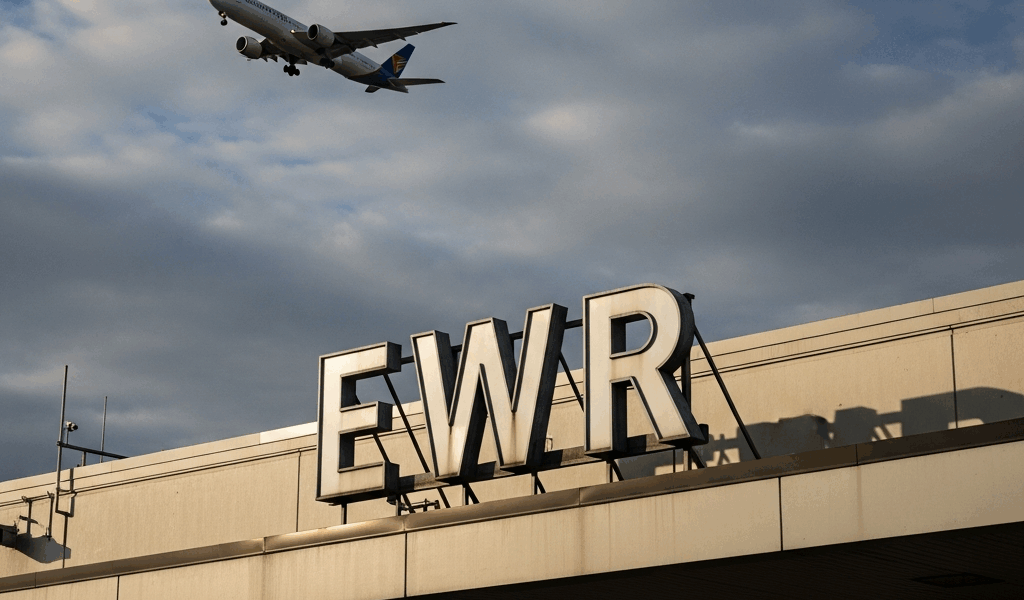
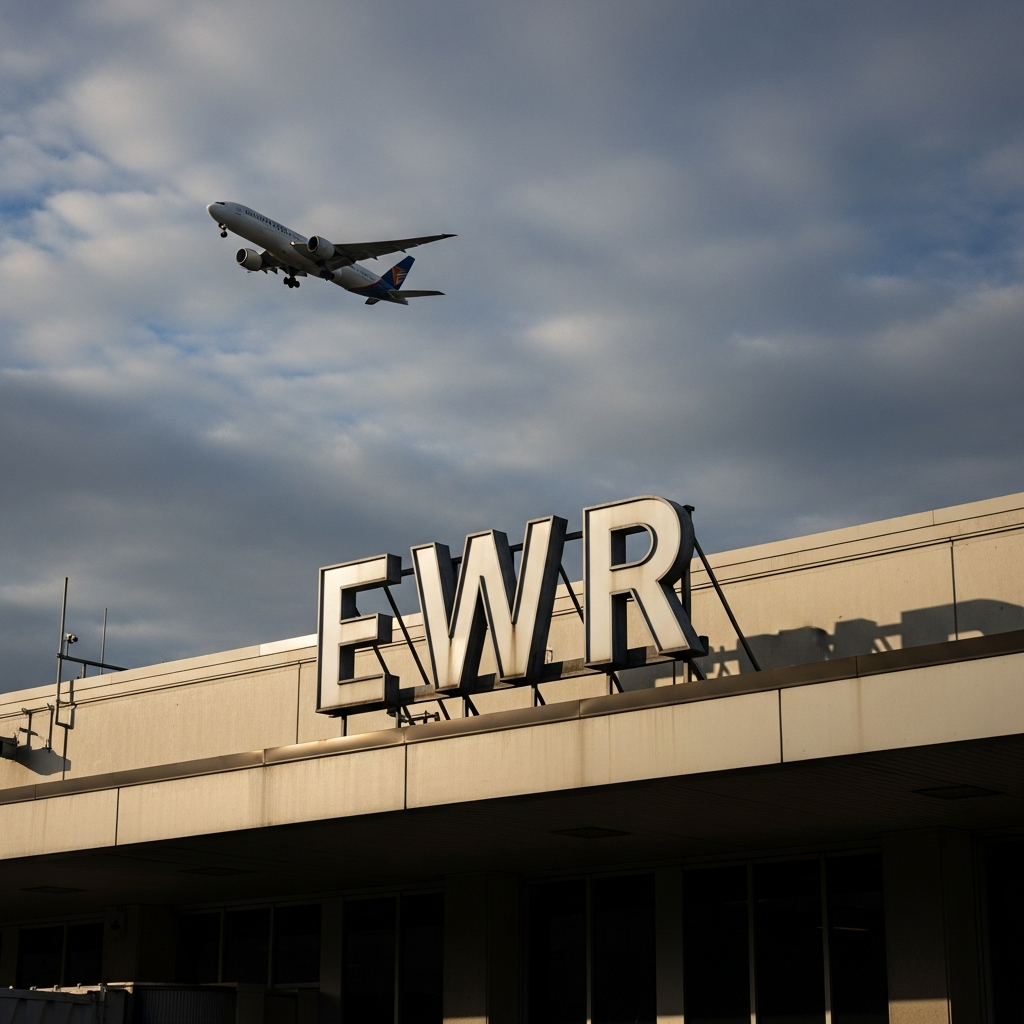
EWR is the IATA airport code for Newark Liberty International Airport in Newark, New Jersey. The letters are taken from the name NEWaRk rather than forming a separate phrase. In other words, EWR does not expand to three words: it identifies Newark.
The less satisfying part of the story is that the original code-assignment record is not readily available in the public primary sources reviewed for this guide. The familiar explanation says an obvious N-starting code was unavailable because N identifiers were associated with U.S. government or Navy use. That explanation is plausible and repeated widely, but it should not be presented as a documented IATA assignment memo unless such a record is produced.
EWR meaning at a glance
| Identifier | Meaning | Where travelers see it |
|---|---|---|
| EWR | IATA location code for Newark Liberty International Airport | Tickets, baggage tags, airline schedules, booking sites, and departure boards |
| KEWR | ICAO location indicator used for the same airport | Flight planning, air traffic, weather, and operational material |
| Newark Liberty International Airport | Official airport name | Airport signs, maps, government and Port Authority material |
The FAA lists Newark Liberty International as EWR (KEWR). IATA’s official airport-code directory identifies EWR with Newark Liberty International Airport. Those are the dependable facts behind the code.
Why does Newark use EWR instead of NWK or NEW?
EWR works as an extracted abbreviation: the letters appear in order inside NEWRark. Airport codes do not have to use the first three letters of a city, and once a code is established it normally remains stable because airlines, reservation systems, baggage operations, charts, databases, and passengers all depend on it.
Two claims are often blended into one explanation:
- The directly observable fact: EWR comes from letters in Newark and is the airport’s official IATA code.
- The historical explanation: Newark could not use a code beginning with N because such identifiers were reserved for U.S. Navy or government use.
The FAA’s history of U.S. aircraft registration confirms that the Navy used the radio letter N beginning in 1909 and that the U.S. government had reserved N for itself in the early radio-identification system. That history helps explain why N has special significance in American aviation. It does not, by itself, prove the exact administrative decision that produced EWR as Newark’s airport code.
Likewise, NEW is not a free alternative today: FAA records identify Lakefront Airport in New Orleans with the location identifier NEW. But the fact that NEW belongs to another airport today does not establish the date or reasoning behind Newark’s original EWR assignment. The accurate answer is therefore simple: EWR is formed from Newark; the precise assignment rationale is less completely documented than many airport-code stories imply.
Does EWR stand for “Newark”?
Yes, in the practical sense. EWR represents Newark by selecting three letters from the city name. It is not an acronym such as “East West Runway,” and it does not officially stand for “Elizabeth, Westfield, Rahway” or another three-word phrase.
This pattern is not unusual. Some airport codes reflect a current city or airport name, while others preserve an earlier name or use a non-obvious selection of letters. Chicago O’Hare uses ORD because the site was once known as Orchard Field. Orlando International uses MCO from its earlier McCoy Air Force Base identity. The code is an identifier, not necessarily a readable abbreviation.
EWR versus KEWR: what is the difference?
EWR is the three-letter IATA code most passengers encounter. KEWR is the four-letter ICAO location indicator used in aviation operations. The leading K is used for many airports in the contiguous United States; the remaining EWR identifies Newark in this case.
Both codes point to Newark Liberty International Airport. Seeing KEWR in a flight-tracking, weather, or pilot-oriented source does not mean it is a different airport.
Is EWR in New York or New Jersey?
EWR is in New Jersey, partly within Newark and Elizabeth. It serves the wider New York–New Jersey metropolitan region and is operated by the Port Authority of New York and New Jersey. The Port Authority describes the airport as approximately 14 miles from Manhattan.
That regional role is why airline searches for New York commonly present EWR alongside John F. Kennedy International Airport (JFK) and LaGuardia Airport (LGA). A ticket to EWR is still a ticket to New Jersey, even when a booking tool groups the airport under New York-area choices.
How the airport’s name changed
The airport opened in 1928 as Newark Metropolitan Airport. The Port Authority assumed responsibility for operations in 1948. In 2002, it was renamed Newark Liberty International Airport in memory of those lost in the September 11 attacks. The airport kept EWR through these name changes, illustrating why established codes can remain more stable than public-facing names.
How to use EWR correctly when booking
- Confirm that both the departure and arrival airports show EWR — Newark Liberty International Airport.
- Do not confuse EWR with JFK or LGA; they are separate airports with different ground transportation.
- For an airport pickup, share the airline, terminal, and flight number as well as EWR.
- If an operational source shows KEWR, recognize that it refers to the same airport.
- Check current airport and carrier information before travel because terminals, transportation services, and procedures can change.
Frequently asked questions
What does EWR stand for?
EWR is the IATA code for Newark Liberty International Airport. Its letters are drawn from Newark: nEWRark. It is an identifier rather than a three-word acronym.
Why is Newark airport called EWR?
Because EWR is Newark Liberty International Airport’s assigned IATA code. The code uses letters from Newark. A commonly repeated historical explanation connects the missing initial N with government or Navy identifier conventions, but publicly available primary sources do not provide the original IATA assignment record needed to state that as the sole documented reason.
Is Newark airport EWR or KEWR?
Both identifiers refer to the same airport. EWR is the passenger-facing IATA code; KEWR is the ICAO location indicator used in operational aviation contexts.
Why not use NWK for Newark?
Airport codes are assigned identifiers, not abbreviations that travelers can choose or infer. Newark’s established code is EWR. A plausible-looking alternative such as NWK has no role in airline bookings for Newark Liberty International Airport.
Does EWR count as a New York airport?
EWR is physically in New Jersey but serves the New York metropolitan region. Booking tools may group it with JFK and LGA as a New York-area option.
Bottom line
EWR means Newark Liberty International Airport. The code takes E, W, and R from Newark, while KEWR is the airport’s ICAO identifier. Official FAA, IATA, and Port Authority sources confirm the airport and its identifiers. The popular Navy-reservation explanation supplies historical context, but the exact original EWR assignment should be described with appropriate uncertainty unless a contemporaneous assignment record is available.



Stay in the loop
Get the latest airport pin updates delivered to your inbox.