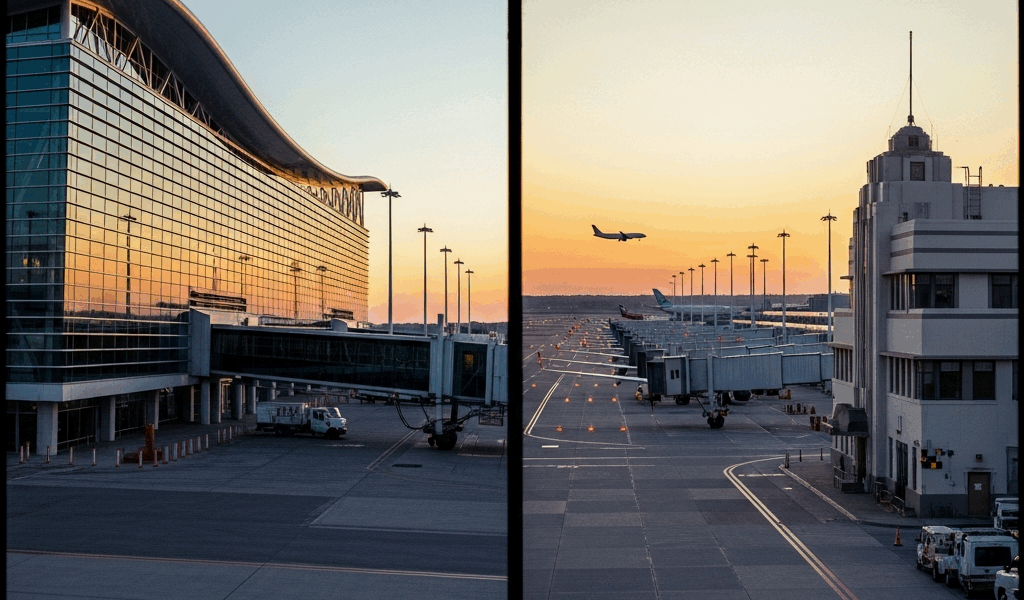
DFW and DAL Are Not the Same Airport
Dallas flights have become harder to navigate with all the misinformation flying around. Every few weeks I help someone book a trip to Dallas and watch them stare blankly when I ask which airport they want. They assume DFW and DAL are just two abbreviations for the same place. They’re not — not even close. Dallas runs two major commercial airports, and they’ve got completely different codes, completely different locations, and honestly, completely different personalities. Today, I’ll share everything I’ve learned about why that is.
How Airport Codes Were Assigned in the Early Days
Airport codes didn’t start as three letters. Before IATA got involved, American airports ran on two-letter weather station codes — functional shorthand assigned by the National Weather Service. It worked fine for a while. Then in 1947, the International Air Transport Association standardized everything into a three-letter system. More descriptive. Easier to track across international travel. The whole industry shifted.
The transition wasn’t clean, though. Airports that already existed had first claim on three-letter versions related to their old codes. Early airports locked down codes tied to their location and history. Airports built later had to work around whatever was already taken. That hierarchy — and the scramble it created — is exactly why Dallas ended up with two separate codes instead of one tidy unified system.
Why Love Field Got DAL First
Love Field opened in 1917 as a military airfield. By the time commercial aviation started booming, it was already Dallas’s established gateway. When the three-letter IATA system rolled out, DAL was the obvious choice — D for Dallas, AL from Love Field’s name. Straightforward. The airport claimed it, and that was that.
For nearly 60 years, DAL meant Dallas. Southwest Airlines built its entire identity around Love Field. Locals knew it. It sat close to downtown, maybe 8 miles out, and the city of Dallas managed it directly. Convenient, familiar, established. Then the region outgrew it.
By the late 1960s, Love Field was straining under the metroplex’s growth. Dallas and Fort Worth jointly planned something bigger — a massive purpose-built facility designed to serve both cities at once. Construction broke ground in 1969. The airport opened in January 1974. That was the beginning of the code problem.
Love Field already owned DAL. The new regional airport couldn’t touch it. City officials from both Dallas and Fort Worth, along with FAA planners, needed a code that actually reflected what the new airport was — a facility serving two cities simultaneously, not just Dallas alone. The answer was sitting right there in the geography.
Why DFW Works and What the Letters Actually Mean
DFW stands for Dallas Fort Worth. That’s the whole story. No legacy accident, no abbreviation of some defunct railway terminal, no inherited weather service code nobody remembers. Just a deliberate, transparent acronym that tells you exactly what it serves.
But what is an airport code, really? In essence, it’s a three-letter identifier assigned to a specific facility for routing, ticketing, and logistics. But it’s much more than that — it’s the shorthand millions of travelers use to make split-second booking decisions, often without understanding what the letters actually mean or where they came from.
Most codes are historical accidents. Boston’s BOS came from Boston Airport Company staking a claim early. Other cities got stuck with abbreviations of old names nobody uses anymore. DFW is refreshingly literal by comparison. The airport authority, both cities’ leadership teams, and the FAA aligned on the name and code simultaneously. No turf war. No compromise code nobody loved. The new airport needed an identity, and DFW delivered one that actually made sense.
Frustrated by this exact confusion, I spent about two weeks digging into the history after a client booked the wrong Dallas airport — twice in one month. I’m apparently the kind of person who goes full research spiral over airport codes, and honestly, that deep dive works for me while a quick Google search never quite scratches the itch. Save yourself the trouble I had of assuming it’s a simple answer. It’s straightforward once you know it, but almost nobody does.
The Two-Airport Situation Travelers Still Get Wrong
Worth flagging before going further. Because the history is interesting, but this is the part that affects your actual trip.
Here’s what matters on the ground:
- DFW International is the mega-hub. International routes, massive daily volume, American Airlines operating its largest connection point there. It sits roughly 18 miles north of downtown Dallas. Cab fare runs $40–55 depending on traffic and surge pricing — budget 35 to 45 minutes minimum during peak hours.
- Dallas Love Field (DAL) is smaller, closer — about 8 miles from downtown — and Southwest Airlines dominates it. Cab fare typically runs $18–28. Twelve to fifteen minutes on a good day. Convenient, but limited on international routes and overall capacity.
The Wright Amendment shaped all of this. Passed in 1979, that federal regulation restricted Love Field flights to specific nearby states, deliberately protecting DFW’s growth during its critical early years. It was partially lifted in 2014. Love Field never became a full international hub — it stayed Southwest’s domain, useful for domestic routes and not much else beyond that.
The two-code system is logical once the histories and distinct roles of the two Dallas-area airports are understood. DAL exists because Love Field was there first. DFW exists because the region needed something bigger and couldn’t use a name already taken. Two airports. Two codes. Two completely different experiences.
Book DFW when you meant Love Field and you’ve added roughly an hour to your day and dropped an extra $30 on cab fare. Book DAL when you need an international connection and you’re rebooking from baggage claim. So, without further ado: DFW is the big airport north of the city — widest airline selection, international gates, American Airlines hub. DAL is the closer airport near downtown — Southwest-dominated, faster to reach, limited internationally. Know the difference before you book. Seriously.



Stay in the loop
Get the latest airport pin updates delivered to your inbox.