The Code That Makes No Sense at First
Airport codes have started getting harder to follow with all the misinformation flying around — especially when the code has absolutely nothing to do with the airport’s actual name. Every time I print a boarding pass at Chicago O’Hare, the same three letters stare back at me: ORD. Not CHI. Not OHA. Not anything that connects to “Chicago” or “O’Hare” in any obvious way. I spent an embarrassing amount of time convinced it was a typo the first time I saw it on a luggage tag. It’s not. The mismatch is completely intentional — or rather, it became permanent through a chain of events nobody planned for. The answer is better than you’d expect. It’s basically a ghost story about a name that died but left its initials behind forever.
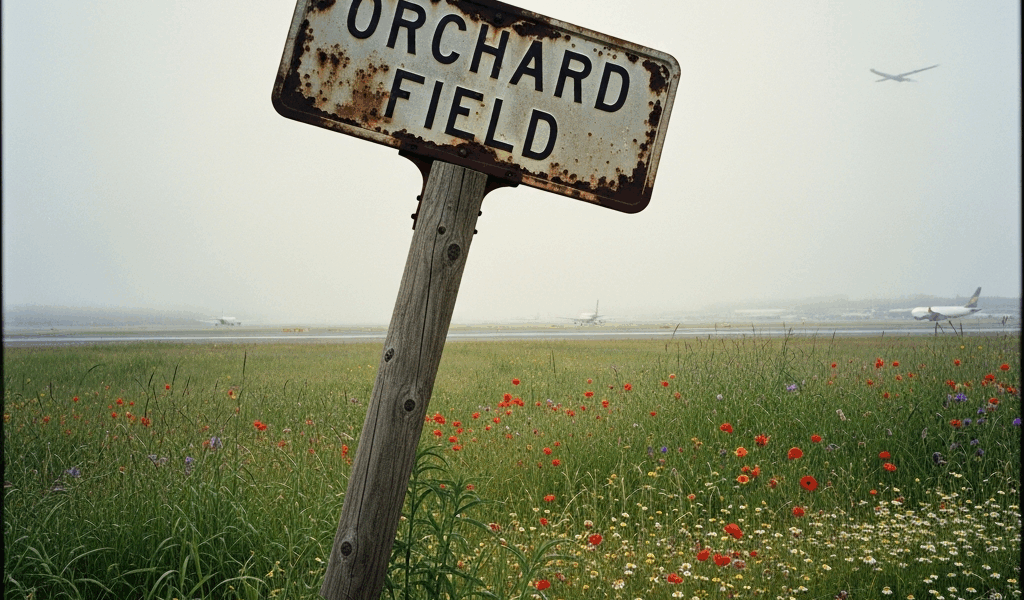
Orchard Field Is Where the Story Starts
Before the terminals. Before the chaos. Before the $19 airport sandwiches that somehow cost $23 by the time you add a water bottle. The land on Chicago’s northwest side served a completely different purpose during World War II.
A Douglas Aircraft manufacturing plant operated on the site — sitting on land that had previously been used for orchard farming. The airfield attached to the plant became known as Orchard Place Airport, sometimes recorded simply as Orchard Field. Military and aviation personnel called it that throughout the war years, and nobody questioned it.
When the International Air Transport Association began assigning three-letter codes to standardize global aviation, Orchard Field got its code: ORD. Clean. Simple. Pulled directly from the name in active use at the time. Airlines started using it. Ticketing systems learned it. The code embedded itself into the infrastructure of commercial aviation the way a splinter embeds itself into wood — quietly, and permanently.
Then 1949 happened. Chicago renamed the airport to honor Edward “Butch” O’Hare, a decorated Navy pilot killed in combat six years earlier. A meaningful tribute. A significant rename. But by the time the new name went up on the signs, ORD had already been circulating for years across reservation systems and cargo manifests worldwide. Nobody changed it. The airport got a new identity, and the old code just stayed — the way a nickname sticks to a person long after the original reason for it has completely faded.
Here’s the part worth saying first. It’s the core of the whole thing.
Why Airports Keep Old Codes After Renaming
Here’s the part that surprises most people. Changing an airport code isn’t like updating a contact name in your phone. IATA codes are wired into airline reservation systems, flight operations software, international customs databases, baggage routing technology, and thousands of printed materials across dozens of countries. Swapping three letters means cascading updates across every single one of those systems — simultaneously, without breaking active flight operations. That’s not a Tuesday afternoon project.
Portland, Oregon offers a clean parallel. Portland International Airport’s code is PDX. The X doesn’t stand for anything obvious in the airport’s current name. It traces back to an older convention where American airports sometimes added X to distinguish themselves from existing railroad station codes. Portland’s station was PD. The airport became PDX. That’s it. No deeper meaning. PDX held because nobody had a strong enough reason to fight for something else.
This is one example of how modern aviation infrastructure preserves much older identifiers. Once a code is issued and operating systems attach to it, it becomes essentially permanent. The cost and disruption of changing it almost always outweighs whatever clarity a new code might offer. So old names haunt current airports in three-letter form, indefinitely.
Who Was Butch O’Hare and Why Does It Matter
Edward Henry “Butch” O’Hare was born in St. Louis in 1914. Grew up partly in Chicago. Attended the United States Naval Academy and graduated in 1937, then became a naval aviator. So far, fairly standard military biography.
Then February 20, 1942 happened — barely two months after Pearl Harbor.
Flying a Grumman F4F Wildcat, O’Hare intercepted nine Japanese Mitsubishi G4M bombers approaching the USS Lexington. His wingman’s guns jammed early in the engagement. O’Hare kept flying. Alone, in a single-engine fighter with limited ammunition, he attacked the formation repeatedly — shooting down five bombers and damaging a sixth to protect his carrier. The entire engagement lasted roughly four minutes. Four minutes.
President Roosevelt awarded him the Medal of Honor. He became the United States Navy’s first flying ace of World War II. He was 27 years old at the time.
Pulled back from combat temporarily because of his symbolic value to the war effort, O’Hare eventually returned to active duty. He was killed in aerial combat on November 26, 1943, during a night mission in the Pacific. He was 29.
When Chicago renamed its airport in his honor in 1949, it wasn’t a bureaucratic gesture. The city wanted his name on something permanent — something millions of people would pass through every single year. O’Hare International now handles roughly 68 million passengers annually. They succeeded well beyond anything anyone could have anticipated sitting in a city planning meeting in 1949.
So What Does ORD Actually Stand For Today
But what is ORD, technically? In essence, it’s an abbreviation for Orchard Field — the wartime name of a manufacturing airfield that no longer exists in any form except those three letters on your boarding pass. The orchard farmers are long gone. The Douglas Aircraft plant is gone. The name Orchard Field hasn’t appeared on a map or a sign in over 75 years. It lives exclusively as an airport code.
IATA codes, once issued, don’t retire just because the rationale behind them has. They become load-bearing infrastructure — invisible to most passengers, absolutely critical to everyone else. Every airline flying into Chicago, every baggage system in every connecting airport, every travel app on your phone knows ORD. Introducing a new code would break more things than it would clarify. The math never works out in favor of changing it.
So ORD persists. A three-letter artifact from a wartime airfield, outlasting the name that created it by three-quarters of a century and counting. Next time someone at the gate squints at their boarding pass looking confused, you can tell them exactly what they’re looking at — a code older than the airport’s actual name, and probably older than their grandparents’ first flight.
Skip past the mistake I made and spend years just assuming it was a typo.



Stay in the loop
Get the latest airport pin updates delivered to your inbox.