I Used to Hate Airports
I’ll be honest — for the first couple years I traveled regularly, airports stressed me out. I didn’t understand the layout, I was always running to my gate, and I once stood in the wrong security line for twenty minutes before someone pointed me to the right terminal. It took a lot of flights and a lot of mistakes before I figured out how airports actually work.
Now I’m the person friends text at midnight asking which terminal their airline uses at JFK. So here’s everything I’ve learned about getting through US airports, from the moment you walk in until you’re seated on the plane.
How Airports Are Laid Out
Terminals, Concourses, and Gates
These three words get thrown around interchangeably, but they mean different things. A terminal is the main building — where you walk in from the curb, check bags, and go through security. Big airports have multiple terminals, each serving different airlines.
A concourse is the long hallway extending from the terminal that has all the gates. They’re usually labeled with letters — Concourse A, B, C — or sometimes numbers. Gates are the specific spots where you board your plane, like B42 or D17.
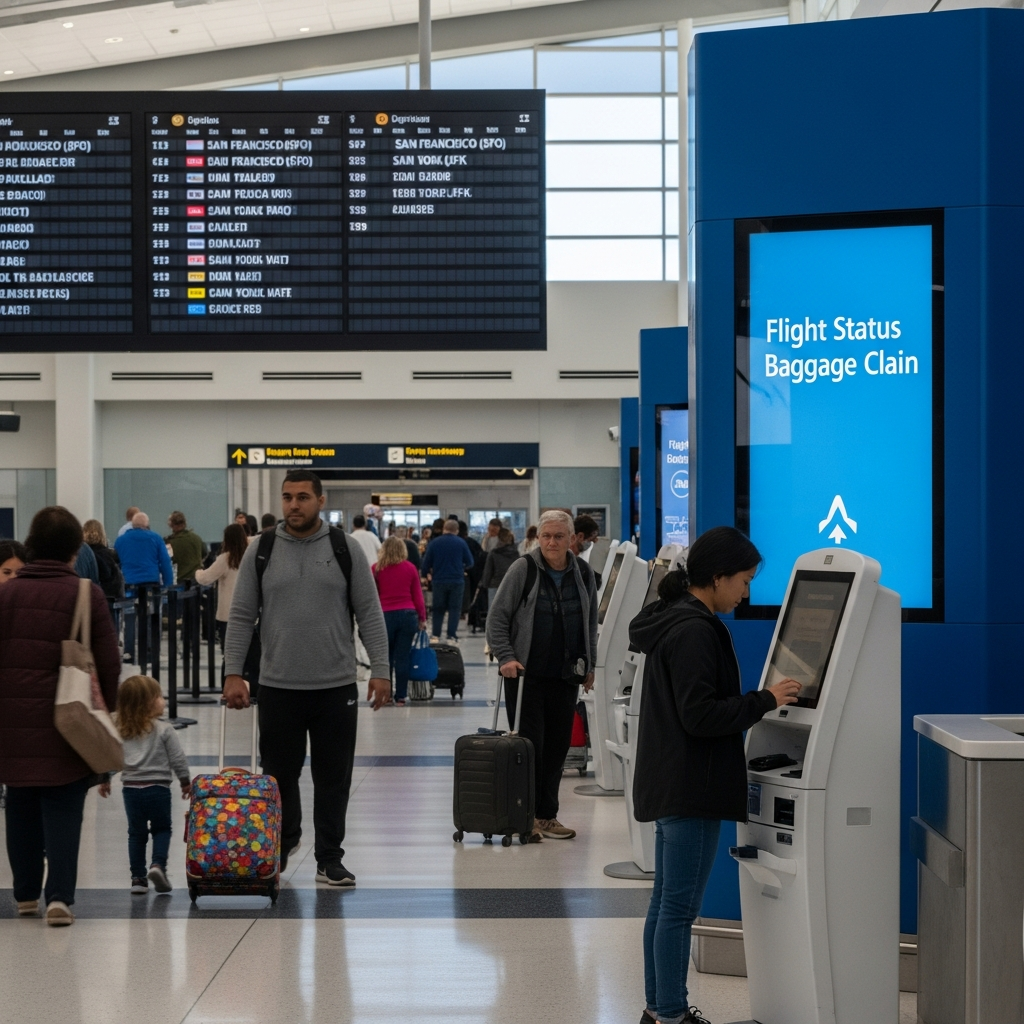
Here’s something I wish someone had told me earlier: gate assignments change all the time. Don’t just look at your boarding pass and head to that gate without checking the airport monitors. I’ve walked to the wrong gate more than once because I trusted my boarding pass instead of the screens. Check the monitors, always.
Pre-Security vs. Post-Security
Airports split into two zones. Landside is everything before security — check-in counters, bag drop, the entrance area. Anyone can walk around landside, even people who aren’t flying.
Airside is everything after security — gates, most restaurants and shops, lounges. Only ticketed passengers get through to airside. Once you’re past security, you stay airside until you exit at your destination. understanding this split answers half the questions first-time flyers ask.
Before You Leave the House
Check-In Options
You’ve got a few ways to check in, and I’d rank them in order of convenience:
Mobile check-in through your airline’s app is the move. Do it 24 hours before your flight and get a digital boarding pass on your phone. I do this the night before while packing and it takes maybe 30 seconds.
Web check-in through the airline’s website lets you print a boarding pass at home. Fine if you prefer paper, but I haven’t done this in years.
Kiosk check-in at the airport uses those touch-screen machines near the ticket counters. They print your boarding pass and bag tags. Lines are usually shorter than the agent counter.
Counter check-in with a human agent is still necessary sometimes — unaccompanied minors, special assistance needs, complicated itineraries, oversized bags, or international flights requiring document verification. But for a standard domestic flight, you shouldn’t need to wait in that line.
Packing Smart
The TSA 3-1-1 rule for liquids in carry-ons: containers of 3.4 ounces or less, all fitting in one quart-sized clear plastic bag, one bag per person. I keep a pre-packed toiletry bag that always meets this, so I never have to think about it.
Checked bags usually get a 50-pound weight limit with standard dimensions of 62 linear inches total. Overweight fees are brutal — $100 or more at some airlines. Weigh your bag at home. I bought a $10 luggage scale years ago and it’s paid for itself many times over.
Always put medications, valuables, electronics, important documents, and one change of clothes in your carry-on. I learned this after an airline lost my checked bag for three days during a work trip. Showing up to a client meeting in the same clothes I flew in was not great. Never again.
Getting Through Security
TSA PreCheck, Global Entry, and CLEAR
TSA PreCheck ($78 for five years): You keep your shoes, belt, and light jacket on. Laptops and liquids stay in your bag. It’s faster and less annoying. If you fly more than twice a year, just get it. I genuinely consider it one of the best travel investments I’ve made.
Global Entry ($100 for five years): Includes everything PreCheck offers plus expedited customs when returning from international trips. Automated kiosks let you skip the immigration line. If you travel internationally at all, the extra $22 over PreCheck is a no-brainer.
CLEAR ($189 per year): Uses fingerprints and eye scans to verify your identity, letting you skip the ID check part of security. It stacks with PreCheck — you use CLEAR to skip the ID line, then PreCheck to go through the expedited screening. Expensive, but at busy airports it shaves off significant time.
Standard Security
Without PreCheck, here’s the drill. Laptops come out of bags. Liquids go in a separate bin. Shoes off, belt off, jacket off. Empty your pockets completely — phones, wallets, keys, everything goes in the bin.
Then you walk through either a metal detector or a full-body scanner. If something triggers an alert, or you get randomly selected, there’s additional screening which might include a pat-down. Stay calm and cooperate. Getting frustrated doesn’t speed anything up. I say this as someone who spent his first few years of travel getting visibly annoyed at security — it helps no one.
Avoiding Delays
Empty water bottles before you get to security. Forgotten stuff in pockets triggers alarms and slows everything down. Large electronics beyond laptops — tablets, gaming devices — might need separate bins. Wear slip-on shoes and skip the heavy jewelry. Small stuff, but it adds up when multiplied by the person doing it in front of you. And behind you. And everywhere.
Navigating Big Airports
Getting Between Terminals
At big hub airports, you might need to move between terminals or concourses for connections. The options vary by airport.
Automated trains: Atlanta’s Plane Train, Denver’s train system, Dallas’s Skylink — these connect terminals in minutes. Follow the signs and listen for stop announcements. I love these systems when they work, and they usually do.
Shuttle buses: JFK and some others use buses between terminals. They run frequently but take longer than trains. Factor in wait time and travel time — maybe 15-20 minutes total in my experience.
Walking: Sometimes terminals connect via indoor walkways. This works for nearby gates but gets impractical at large airports. At DFW, for example, walking between terminals would take forever. Use the Skylink.
Gate Changes
I mentioned this earlier but it bears repeating: gates change constantly. Aircraft swap, delays cascade, operational stuff happens. Always verify your gate on the departure monitors, not just your boarding pass. Turn on push notifications in your airline’s app — I’ve gotten gate change alerts while sitting at the wrong gate and made it to the new one with time to spare. Without that notification, I would have missed the flight.
Connection Times
Airlines publish minimum connection times, and technically they’re enough. But “enough” means you’re speed-walking through the airport with zero margin. Here’s what I actually book:
For domestic connections, I aim for 60-90 minutes minimum. At complex airports, closer to 90. For international connections requiring customs, 2-3 hours at least. At JFK where you might need to change terminals and re-clear security? Even more. I’d rather sit in a lounge for an extra hour than sprint through a terminal with my carry-on bouncing behind me.
Airport Food and Shopping
Dining
Airport food has gotten genuinely better over the last decade. Major airports now have outposts of actual good local restaurants, not just the same five chains repeated across every terminal. Prices are still 10-20% higher than outside the airport, which is annoying but at least the quality has improved.
Portland (PDX) deserves special mention here — they mandate street pricing at their airport, so food costs the same as downtown. More airports should do this, but PDX remains the exception.
If you’re trying to eat healthy, most bigger airports now have salad bars, smoothie spots, and fresh food markets alongside the usual fast food. Apps like App in the Air can help you figure out what’s available at your specific terminal before you get there.
Shopping
Duty-free shops in international terminals sell alcohol, cosmetics, and luxury goods without tax. The savings are real on some items and completely nonexistent on others — compare prices on your phone before assuming duty-free equals cheap. I got burned once buying cologne that was actually more expensive than what I would have paid at a department store. Lesson learned.
For forgotten essentials — chargers, headphones, travel pillows — the airport will happily sell you everything you need at a premium. A $12 phone charger outside costs $25 at the terminal shop. Pack your stuff and you avoid the markup.
Other Services
Bigger airports have massage places like XpresSpa, which charge a lot but can make a long layover feel less terrible. Business centers with printing and private workspaces exist at some airports. Art installations and even small museums show up in surprising places — SFO has an actual museum in the international terminal. Yoga rooms and meditation spaces are popping up at more airports too, if that’s your thing.
When Things Go Wrong
Weather Delays
Weather disruptions are nobody’s fault, and getting angry at the gate agent won’t make the thunderstorm move faster. Ground stops halt departures to affected areas. Ground delays keep planes at gates until airspace opens up.
What you should do: stay glued to your airline app and airport monitors. If your flight gets canceled, get in the rebooking line immediately. Every minute you wait is another person ahead of you competing for the same seats. I’ve also had luck calling the airline’s phone line while simultaneously standing in the gate line — whichever resolves first wins. Airline Twitter accounts can sometimes help too.
Mechanical Issues
When the pilot announces a mechanical delay, I get it — it’s frustrating. But these delays exist because something needs to be fixed before it’s safe to fly, and I’ll take a late departure over a unsafe one every time. Airlines may swap aircraft or cancel depending on the issue.
For delays of several hours, you might get food vouchers. Overnight delays sometimes come with hotel accommodations depending on the airline’s policy and whether they caused the problem. Ask — the worst they can say is no.
Missed Connections
If you miss your connection because of an airline-caused delay (their flight was late), the airline is responsible for getting you on the next available flight. If you missed it because you showed up late or spent too long at the lounge bar — well, that’s different and they may be less accommodating.
Approach gate agents calmly. Having a specific backup plan helps: “Can you put me on the 4pm to Dallas?” gets results faster than “What do I do now?” Elite status helps with priority rebooking, but being polite and specific works for everyone.
International Travel Extras
Customs and Immigration
Coming back to the US means clearing customs and immigration. Global Entry members use automated kiosks and breeze through. Standard lines can take 30-60 minutes at peak times — I’ve seen even longer at MIA during the winter season when everyone’s returning from the Caribbean.
Have your passport and customs declaration form ready before you reach the front of the line. Answer questions honestly and briefly — the agent isn’t looking for your life story. After clearing immigration, grab your checked bags and walk through customs inspection.
If you’re connecting to another domestic flight after an international arrival, you’ll need to re-clear security. Plan 2-3 hours minimum for international connections because of this extra step.
Money and Connectivity Abroad
Don’t exchange currency at the airport — the rates are terrible. Use ATMs at your destination for better rates, or get a travel credit card with no foreign transaction fees. I use the Capital One Venture X for this and it’s worked everywhere I’ve been.
For phone service, eSIMs are the move now. You activate them without swapping physical SIM cards, and they work in most countries. I set one up for a Europe trip recently and it took five minutes through an app. Way easier than hunting for a SIM card vendor after landing.
Accessibility and Special Needs
Airlines provide wheelchair assistance, escorts through security, and connection help for passengers who need it. Request when booking or at least 48 hours before departure — last-minute requests are harder to accommodate.
Service animals fly free in the cabin with proper documentation. The rules around emotional support animals have tightened significantly though, so check current requirements if you’re planning to fly with any animal.
Medical equipment like CPAP machines, portable oxygen, and insulin have specific TSA screening procedures. Carry documentation and arrive early for extra screening time. Let gate agents know about any conditions that affect boarding or seating — pre-boarding for people needing extra time is standard.
Apps That Actually Help
Your airline’s app is non-negotiable. Boarding passes, flight status, rebooking during disruptions — it handles it all. Download it before you travel and turn on notifications.
FlightAware and FlightStats track flights with delay predictions. I check FlightAware when my inbound aircraft is coming from somewhere with weather, just to get ahead of potential delays.
TripIt organizes multi-leg trips into a single timeline. Useful for complicated itineraries.
Many big airports also have their own apps with terminal maps, wait estimates, and food directories. At airports like LAX, JFK, and ORD, these can help you figure out where things are without wandering around reading signs.
Airport-Specific Tips
Atlanta (ATL)
Busiest airport in the world by passenger count, but it runs surprisingly well. The Plane Train connects all concourses in under five minutes. Domestic flights use Concourses T through D. International primarily from Concourse F and the International Terminal. The South security checkpoint usually has shorter lines than Main. Allow 45 minutes minimum for connections between distant concourses.
Los Angeles (LAX)
LAX’s U-shaped layout is a pain. Terminals don’t connect airside, so if you need to switch terminals for a connection, you have to leave security and re-screen. The automated people mover that opened in 2024 helps with this a lot. Traffic getting to LAX is legendary — the FlyAway bus from Union Station is a more predictable option than driving or rideshare during rush hour.
Chicago O’Hare (ORD)
Terminals 1, 2, and 3 connect airside through underground tunnels. Terminal 5 handles international flights and requires a bus transfer from other terminals. O’Hare’s central location means weather delays here affect flights across the whole country. Winter travel through ORD is a gamble. Build generous connections and maybe consider travel insurance for December and January bookings.
Dallas/Fort Worth (DFW)
Huge airport — one of the largest by area in the US. Skylink is the automated train connecting all five terminals, and it runs 24 hours during flight operations. Don’t try to walk between terminals; it’s not practical. American Airlines dominates here as their biggest hub. Terminal D has most international flights plus the Admirals Club and the new Capital One Lounge.
Denver (DEN)
You’ll recognize it by the white tent-roof structure. A train connects the main Jeppesen Terminal to three concourses — everyone clears security before getting on the train. DEN sits 25 miles from downtown Denver, so plan your ground transportation. The A-Line commuter rail runs $10.50 each way and is reliable. Airport parking fills up fast during holidays.
San Francisco (SFO)
Four terminals connected by AirTrain. BART provides rail access to downtown and the East Bay. Here’s the thing about SFO: fog. Especially summer mornings — yes, summer. SFO fog delays are a regular occurrence, and airlines show delays before canceling. Build buffer time into morning departures. I’ve been delayed at SFO more than any other airport, and it’s almost always weather.
JFK (New York)
Six terminals that don’t connect airside. The AirTrain circles the airport connecting everything. Inter-terminal connections require time and planning — don’t book tight connections at JFK if you’re changing terminals. Terminal 5 is JetBlue’s impressive home base. Terminal 4 handles Delta and many international carriers. Terminal 8 is American’s territory.
Miami (MIA)
Primary gateway to Latin America and the Caribbean. American Airlines runs most of the operation here. Concourses connect post-security, so connections within the airport are pretty straightforward once you’re inside. Metrorail connects to downtown Miami. International arrivals face long immigration lines — Global Entry is especially worth it if you fly through MIA regularly.
Looking Ahead
Biometric screening is spreading — facial recognition for boarding and customs at more airports each year. Delta offers it at several locations. Privacy concerns are real, but you can opt out in most situations. It just takes longer the old-fashioned way.
Airports are also pushing sustainability — solar power, electric ground vehicles, water reclamation. You can do your part with a reusable water bottle (fill it after security), fewer single-use plastics, and public transit to the airport instead of individual car services.
Contactless everything accelerated during COVID and it’s staying. Mobile boarding passes, touchless payments, digital bag tags — all of this is standard now and makes the process smoother for everyone.
Bottom Line
Airports don’t have to be the worst part of flying. Once you know how things work, most of the stress evaporates. Arrive with enough time, know your options before problems happen, and stay calm when things go sideways.
Build in buffer time, especially at unfamiliar airports. Invest in TSA PreCheck or Global Entry if you fly regularly. Download your airline’s app. Pack smart. And be nice to the people working at the airport — they’re dealing with hundreds of stressed travelers every day, and the polite ones always get better help.
The airport is just the start and end of wherever you’re going. Make it work for you instead of against you, and you’ll actually enjoy the whole travel experience a lot more.



Stay in the loop
Get the latest airport pin updates delivered to your inbox.