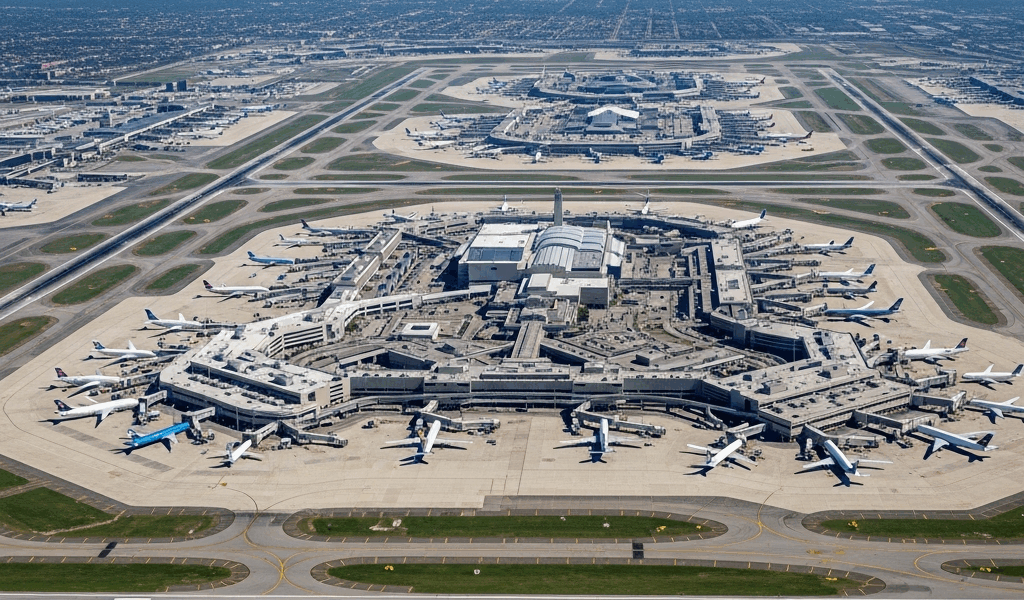
You just flew into Chicago O’Hare and your luggage tag says ORD. Not CHI, not OHR — ORD. The world’s third-busiest airport has a code that doesn’t match “O’Hare” at all. That’s because the code is older than the name.
What Does ORD Actually Stand For?
ORD stands for Orchard Field — the original name of the airport before it was renamed O’Hare International Airport in 1949. When IATA assigned the three-letter code, the airport was still called Orchard Field, and ORD stuck. Airports that change names typically keep their original IATA code because the code is embedded in every airline reservation system, every baggage routing database, and every air traffic control procedure worldwide. Changing a code is exponentially harder than changing a sign on a building.
From Wartime Factory to International Airport
The site started as a Douglas Aircraft Company manufacturing plant during World War II, producing C-54 Skymaster transport aircraft. The factory needed an airfield for test flights and deliveries, and the adjacent farmland — known as Orchard Place — provided the space. The airfield was called Orchard Field, and ORD was assigned as its identifier.
After the war, the City of Chicago took over the site in 1946 and began converting it to a commercial airport. In 1949, it was renamed O’Hare International Airport in honor of Lieutenant Commander Edward “Butch” O’Hare, a Navy aviator and Medal of Honor recipient from Chicago who was killed in action in 1943. O’Hare was the Navy’s first flying ace of World War II — a legitimate local hero whose name carried weight.
The rename happened. The code did not change. Seventy-five years later, ORD still marks every bag, every flight plan, and every ticket through Chicago’s primary airport.
Why They Didn’t Change the Code
By 1949, ORD was already in use across early airline systems. IATA codes are deeply embedded in infrastructure — they route baggage, identify airports in flight plans, and appear in every reservation system. Changing a code requires updating every connected system simultaneously, which is why it almost never happens. The name on the terminal changed; the code in the computer stayed the same.
Chicago’s other airport, Midway, has a similarly historical code: MDW. But in that case, the code actually matches the name — Midway was named after the Battle of Midway in 1949 (same year as O’Hare’s renaming), and its code was assigned around the same time.

Stay in the loop
Get the latest airport pin updates delivered to your inbox.